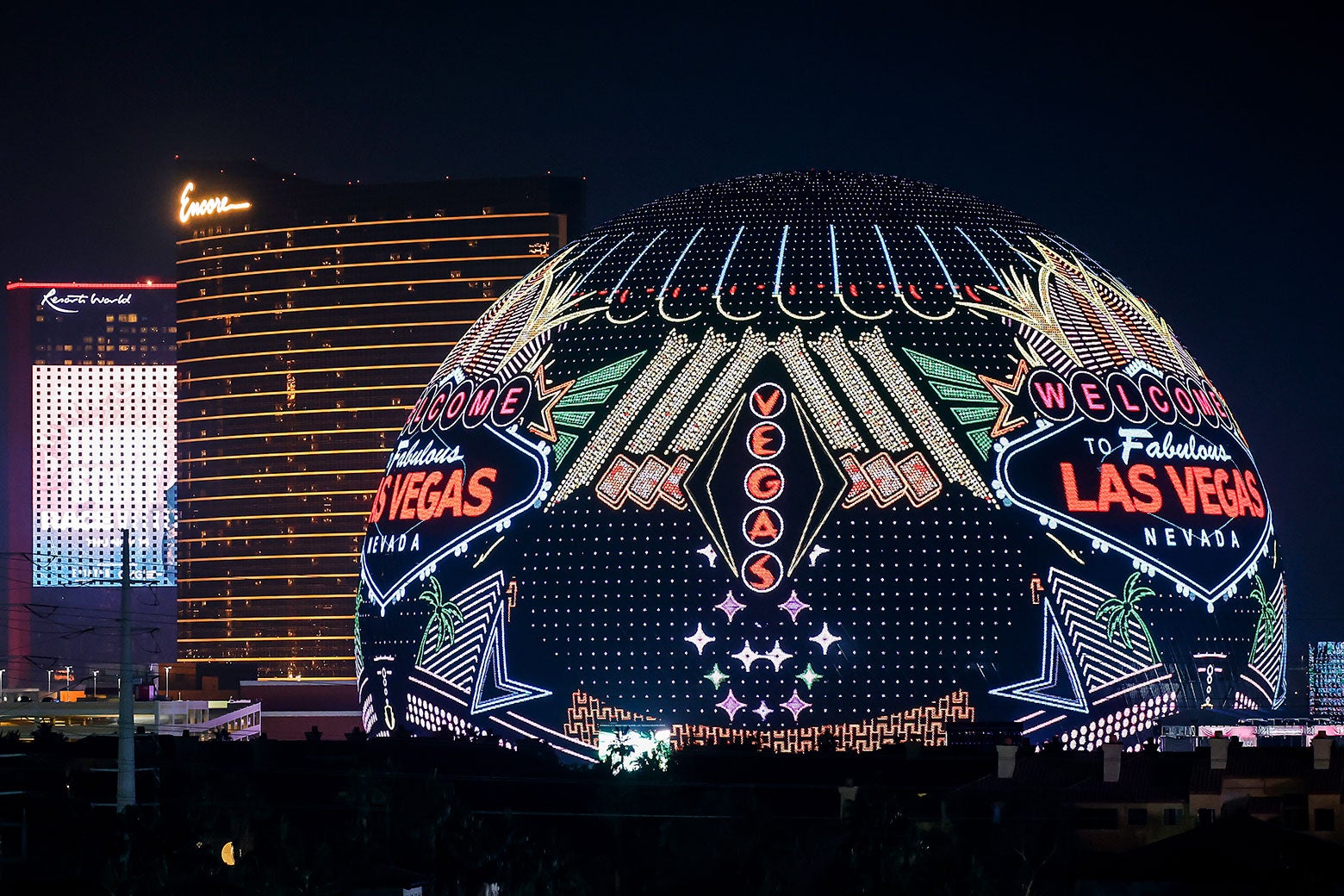
At the risk of sounding like a curmudgeon, there has always been something about the Sphere that’s rubbed me the wrong way. The orbicular theater, uncanny and monolithic, is parked like a spaceship on the northern reaches of the Las Vegas Strip with technical specifications that boggle the mind. The Sphere, fashioned by MSG Entertainment, contains a 160,000-square-foot wraparound LED screen, equivalent to about three football fields, that pumps out crystalline images so bright, clear, and rich with detail that they threaten to melt the skin off your bones.
It’s a genuinely remarkable work of technology—I am not trying to be a Luddite here. Instead, my gripes are more philosophical. When the Sphere opened to the public in 2023 with a U2 residency, I watched as clips circulated through social media of Bono—a man who has thought longer and harder about the subtleties of being a compelling rock musician than almost anyone who has ever lived—dwarfed by a hypersaturated vista of mountains, and deserts, and sunlight, glowing on the monstrous Titantron behind him. Bono was performing “Where the Streets Have No Name,” a song about the resilience of the human spirit, and I just found something depressing about all 20,000 people in the Sphere contemplating those ideas—singing along, hands in the air—while nevertheless staring at the largest television anyone has ever built. Is the point of live music to be humbled by the overwhelming forces of machinery? Or, perhaps, is it more rewarding to connect with the people playing the instruments? It seems like an easy answer to me.
But whatever—I’m clearly in the minority, because the Sphere has been a runaway success. Artists turn to the theater to inject some much-needed juice into ailing concert tours: The Backstreet Boys wielded every ounce of the Sphere’s indomitable stature to distract from the fact that the principal members are all in their 40s and 50s. The Eagles seem to be at the Sphere all the time now, perhaps because a high-fidelity light show is required to stay awake for the entirety of “Hotel California.” Phish will be making landfall in the structure next year, which is a match made in heaven, and the same goes for the reunited—and increasingly depressing—No Doubt. (Kenny Chesney will also be taking his talents to the Sphere in 2026, but the less said about that, the better.)
However, on the vacant dates, when a legacy act isn’t occupying center stage, the venue has managed to squeeze out tourist dollars by morphing into a prohibitively expensive movie theater. More specifically, starting in August, anyone in Las Vegas could purchase tickets to twice-daily screenings of a version of The Wizard of Oz that had been retrofitted to meet the Sphere’s gargantuan dimensions. The pitch is simple: With the automating power of A.I., the Sphere could expand the cloistered horizons of Oz—allowing the Yellow Brick Road to serpentine farther into the distance, providing more open sky for the silhouettes of flying monkeys to soar across, and so on. Combined with a juiced soundscape, some CGI flourishes, and a couple of haptic, 4D gimmicks, perhaps you could convince ambling day-trippers to spend $180 on a movie that might as well be in the public domain. It felt like a pretty hard bargain to me, but I was already in town reporting on Las Vegas’ precipitous decline. A trip to the Sphere—which the city appears to be banking on to salvage its flagging tourism numbers—was compulsory.
And so, after traversing the maze of corridors from the gilded Venetian into the Sphere’s foyer, I ascended several steep escalators that make up the structure’s interior—nervously eyeing the vertigo-inducing chasm of the concave interior that slowly spread out below my feet. After arriving at the summit, I found myself perched at a harsh corner in the upper balcony—the cheap seats—with the entirety of my peripheral vision swallowed up by the vast LED canvas. There is no escape in the Sphere. The walls are screens. The ceilings are screens. The floor, swooping underneath you at an impossible angle, is a screen, too. The theater was surprisingly busy for a Thursday afternoon screening, but legends of the Sphere’s indomitability have clearly spread far and wide. (One woman, from California, had taken it upon herself to cosplay in Dorothy’s gingham dress for the occasion. I spied a couple of Elphabas as well.) Once everyone got settled in with their $18 Stellas, the digital curtains peeled apart, and the show rumbled to life. Every inch of the Sphere transformed into an arid, black-and-white Midwestern sky, with the film’s daintily scripted logo hanging in the center, piercing our faces with electric light. There was no doubt about it, we weren’t in Kansas anymore.
The Wizard of Oz, it must be said, was released in the summer of 1939, about a month before World War II splintered across Europe. The most transcendent moment in the film is when Dorothy wakes up in her parallel dimension, and the sepia imagery of the dust bowl drains away to reveal glorious Technicolor. It’s a blockbuster moment that feels absolutely quaint when compared to the roiling horsepower of the Sphere, and—if you are being charitable—you could argue that by presenting a nouveau rendition of that paradigm-shifting splendor for a modern audience, the Sphere honors the original’s legacy. But personally speaking, after settling into this highly digitized interpretation of an all-time classic, my qualms were right in place. If you are a certain type of film nerd, I don’t know how you could come to any other conclusion than that the Sphere’s version of The Wizard of Oz is, in a word, a defilement. The goal is to bring an all-time classic up to zippy, TikTok speed, and that means its producers have allowed themselves some significant liberties.
The run time here has been curtailed significantly, and the gaps left behind have been crammed with gratuitous Marvel-toned gaudiness. You know those opening scenes of Dorothy gallivanting around Kansas, meeting all of the characters who will soon become facsimiles in her dreamworld—providing the thematic underpinning that girds the film together? Articulating a thesis that Dorothy is a resident of a cruel world full of scammers and charlatans who can only be thwarted by the pure of heart? Yeah, a bunch of that has been cut out. In its place is a ridiculous upscaling of the tornado sequence, where the Sphere literally takes us inside the vortex. Thunder booms. Gusts of artificial wind pound the audience. Paper leaves flutter down from the rafters. It is legitimately terrifying, immediately memorable, and, undeniably, a component part of a much different movie than the whimsy and high camp of Oz. (I half-expected Glen Powell to turn up.)
This approach is threaded through the entirety of the Sphere’s remastering. All of the Wizard of Oz’s slow moments have been banished to the Deadly Desert. Remember that scene where the Cowardly Lion is crowned the King of the Forest, and he gets to sing his little song about his majesty? It’s nowhere to be found. But Styrofoam apples do drop from the sky when Dorothy meets those two cranky talking trees in the orchard. The dialogue throughout the movie has been streamlined—the titular wizard has like four lines—in order to make space for the almighty set pieces. The Wicked Witch’s domain looks like Mordor, all craggy, charred, and purple-skied, massively expanding on what was possible with industrial design in the 1930s. The same can be said for the emerald citadels of Oz, which glisten majestically on the outer reaches of the Sphere’s surface. When the producers need the people onscreen, and their Depression-era choreography, to navigate the soundstage they pulled whole-cloth from whirring data centers, they simply reanimate Judy Garland’s skeleton with unsettling A.I. gesticulations—a puppet show from beyond the grave. It’s all impressive. But at what cost? And to what end?
I made my exit from the Sphere feeling confused and slightly dismayed about what I had just witnessed. As I was leaving, I passed through the venue’s atrium, which has been transformed into a miniature museum for the motion picture. Century-old Oz books are splayed open, ruby slippers are on display behind a glass pane. The team seems to believe that they have crafted a winning tribute to the original film, and that my hang-ups had no quarter. According to the Sphere, spectacle is the spice of filmmaking. And here’s the thing. The more I thought about the experience—the more I meditated on this bizarre tension between beauty and soul—my mind kept coming back to the same point: “Man, I’d love to see Empire Strikes Back in the Sphere.” I’m not happy about it, but it’s true.
Do I think a Sphere adaptation of Empire Strikes Back would be a superior product? No, not even close. I imagine the theater gouging out a ton of the Dagobah scenes, where Yoda, in his elliptical way, enlightens Luke on the rudiments of the Jedi code. The production team would shorten the Lando monologues, and the Vader soliloquies, and those wonderfully bleak sequences in the asteroid belt, deeming them too deliberate and knotty for the infinite-scroll generation. The end result would be hollow, contrived, and absent of shaded complexities. But come on, do I want to see Cloud City rendered in 16K? Does the idea of the entire Battle of Hoth playing out across a skyscraper-sized screen get my blood pumping? Absolutely. No matter how existentially troubling I found the Sphere, it did manage to leave me with an enduring body high—an inflammation of my nerve centers. It’s been months now, and I still haven’t broken the fever.
The film industry is in a moment of rapid consolidation. On Friday, news broke that Netflix had acquired Warner Bros., meaning that a streaming service had swallowed up one of the few remaining studios committed to the established codes of Hollywood. Nobody is sure how the power brokers of this business can get butts in seats—to pay for a ticket and watch a story unfold onscreen—or, more grimly, if that should be a priority for anyone anymore. Well, Las Vegas has cracked that code. The world lines up to witness a 90-year-old film disemboweled of its quirks and patient moments, with its light and sound cranked up to previously unimaginable degrees of fidelity, dilating our pupils, beating our brains into docile submission. The Sphere asserts that we all demand pleasure before anything else. Sadly, it might be right.
