Sign up for the Slatest to get the most insightful analysis, criticism, and advice out there, delivered to your inbox daily.
Last February, I was in a remote town in northern Greenland and watching Donald Trump being discussed on the Danish news. My host, a lifelong Greenlander, waved his hand dismissively at the set in his living room and turned to me. “Trump,” he said. “No good.”
It’s a fittingly succinct summation of the general feeling about the U.S. president I encountered during the few weeks I spent in Greenland almost a year ago. I wasn’t there to write about politics, but my trip happened to come hot on the heels of Donald Trump Jr.’s visit to the country and a recent round of Trump Sr. declaring things like “Greenland is an incredible place, and the people will benefit tremendously if, and when, it becomes part of our Nation.”
It was a strange time to be there. The capital city, Nuuk, where I spent five days, was full of journalists, not least because heavy winds meant that flights out of Nuuk were canceled indefinitely and anyone already on the ground had to stay a few extra days. I met some German TV reporters who were in town covering the Trump situation; they told me that they were finding their assignment a little difficult because the city’s residents were sick of talking to reporters about Trump. Nuuk only has 20,000 people, so if you were an adult living in the capital at the time, there was a fair chance you’d been stopped on your way to the supermarket by someone with a recording device.
Just like anywhere in the world, you could find a small scattering of people who have bought Trump’s message, and the red hat besides. There are some in the country who think there’s an opportunity for Greenland to achieve prosperity through some kind of deal with the U.S. But when my German friends did manage to persuade people to give an opinion, it was generally not a positive one. The message, by and large, was that “Greenland belongs to us and to no one else,” as one resident of Ilullisat, Ane Sofie Lauritzen, put it. “I am very worried. The world is suddenly closing in on us,” said another Greelandic woman called Esther Brandt Ahrens. “I am almost 60 years old, but I have never experienced anything like this. We know that Trump is only after our resources.” A poll taken just before I arrived found that 85 percent of people in Greenland did not want to become part of the U.S., with just 6 percent in favor and 9 percent undecided.
I wondered at the time whether this all might prove to be a flash in the pan. Trump spoke about wanting to buy Greenland during his first term too, and he got a pretty firm no from both Greenland and Denmark. But then the world watched Trump storm into Venezuela and arrest its leader without anything resembling an international consequence in recent weeks. In Greenland, that was a different kind of alarm bell.
Though Trump’s ambitions to seize the Arctic state as U.S. territory went quiet for a time after about March of last year, they never went away. Just before Christmas, he appointed an envoy to Greenland, Republican Louisiana Gov. Jeff Landry. “It’s an honor to serve you in this volunteer position to make Greenland a part of the U.S.,” Landry said at the time. Trump did not discuss the appointment with officials in Denmark or in Greenland.
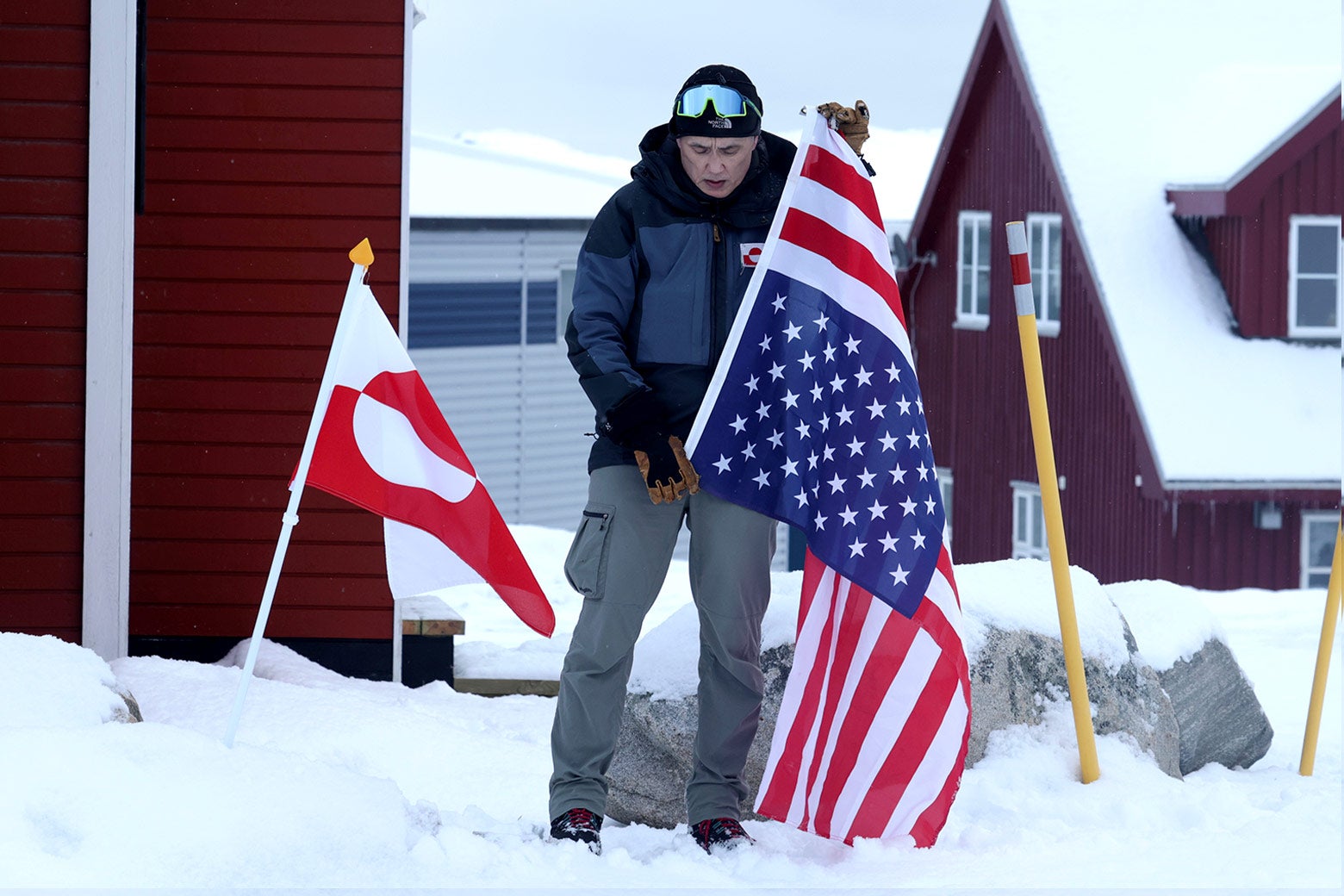
After Nicolás Maduro’s capture, at a press conference held onboard Air Force One, a reporter asked Trump about what his plans were with Greenland now, to which he replied, “We need Greenland from a national security situation.” (He’s previously also said he wants it for its natural resources.) Last week, White House deputy chief of staff Stephen Miller’s wife Katie Miller posted a picture to X of Greenland with the American flag superimposed on it, captioned ominously “SOON.” In response, many Greenlanders are now posting pictures on Facebook of their country proudly emblazoned with the Greenlandic flag.
Last year, I got the sense that while Greenlanders found Trump’s grandstanding about Greenland disrespectful and troubling, they also found the whole thing ridiculous. Now, however, the threat feels more serious. A friend who works with the Arctic Economic Council put it bluntly when he told me the majority of Greenlanders are now “shitting themselves.” Greenlandic officials are, it seems, also furious. The Danish news outlet DR reported on Wednesday that an online meeting between Greenlandic representatives and their counterparts in Denmark descended into accusations by the former against the latter of “neocolonialist” exclusionary practices in holding meetings about the country’s future without including Greenlandic officials.
I caught up with Nicolas, a man I met who has spent the last 30 years living between Paris and Kullorsuaq, a settlement on Greenland’s northwestern coast. He said that in his view, people were more worried about the threat of a U.S. takeover than ever before. He mentioned his local friends’ response to Trump’s offer to give somewhere between $10,000 to $100,000 per person in Greenland. (The country has 57,000 residents total.) “They feel completely offended about that kind of behavior,” he said, “and also they are upset by the fact that, internationally, people ask Denmark about the Trump question, people ask Europe, but no one asks the Greenlanders, and they feel they have no voice. Especially young people.”
He recently put me in touch with his friend Ole Olsvig, a 32-year-old native of a village called Naajaat in Greenland’s northern Upernavik area. “People are exhausted,” he told me. Part of that exhaustion with how their country is discussed internationally stems from deep colonial wounds about their relationship with Denmark. In 2025, for instance, Denmark finally issued an official apology for the widespread program of enforced sterilization of Inuit women without their knowledge. Eventual independence is something many Greenlanders have wanted for a long time. “There has been always a feeling of wanting to be independent; I think it has always been a dream,” he said. A year ago, he remembered seeing a lot of Greenlanders making memes about what he called Trump’s “delusional” desire to take over their country. Things feel different now: “This time, everyone is seeing what’s happening in Venezuela, so now I think people are more afraid of what might happen.”
Unlike last year, their fears are taking real shape. “Will there be isolation? Will towns be centralized? Will people be cut off in terms of supplies, if the U.S. focused on militarization or centralization of administration, for example? All the things that you haven’t imagined last year, now you are discussing,” he said. Still, however, he said most people can’t shake off the sense that it is a ludicrous fantasy of Trump’s that Greenland can just be “sold off for money.”
Whatever is to come their way from the U.S., plenty of Greenlanders have another pressing issue on their minds at the moment. At the time of writing, troublingly warm weather means that sea ice, essential for the hunting season, has still not formed in northern Greenland, and it was expected a month ago. There are other, perhaps even bigger threats to life in the country besides Donald Trump’s desire to buy up what he appears to view as little more than a very large piece of prime real estate. And he’s already making those worse.
