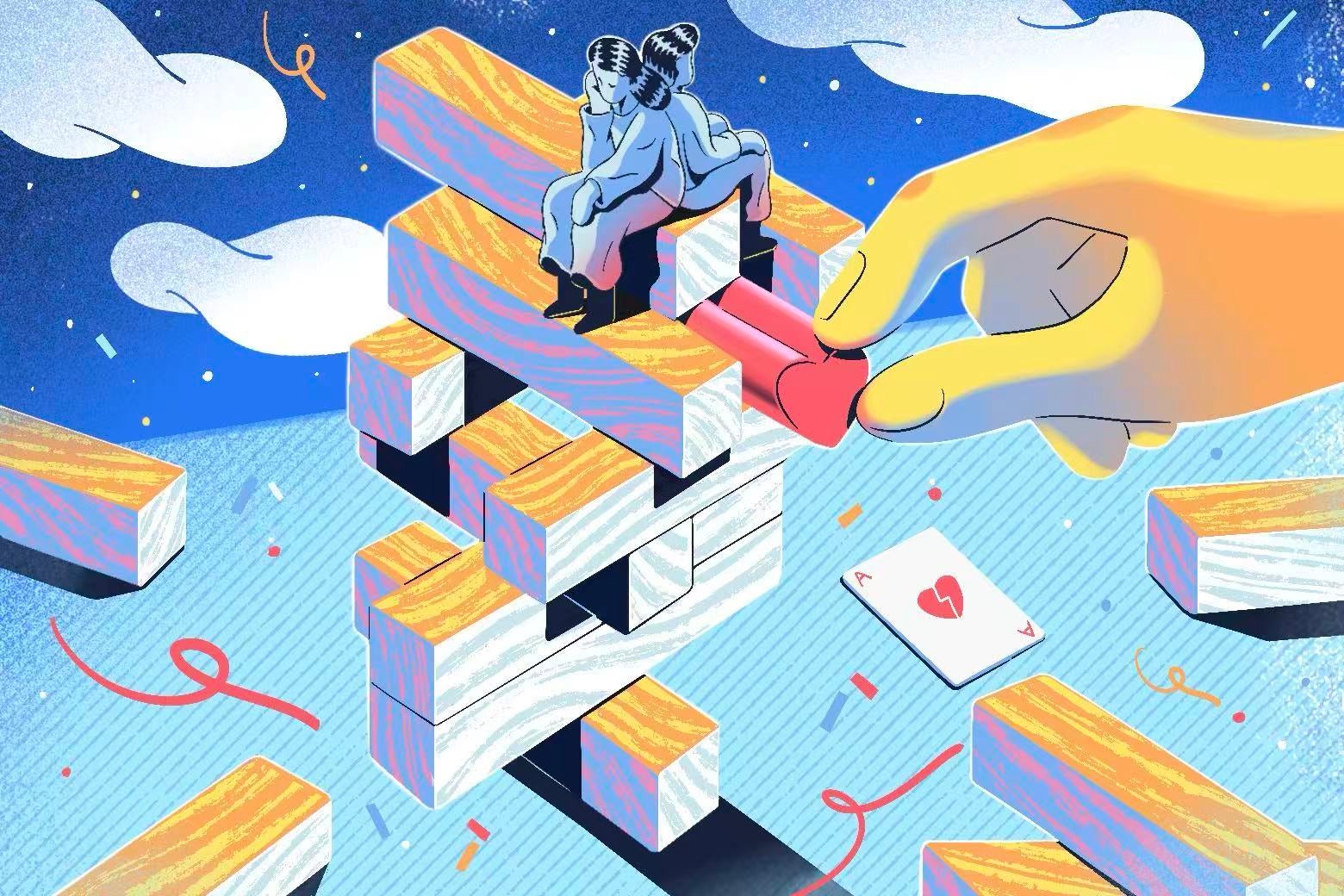
This is part of Breakup Week. We just can’t do this anymore.
Dating was not going well for Pierz Newton-John. A little over a decade ago, the Melbourne-based writer and former psychotherapist was fresh out of a long-term relationship, and he emerged to find that the rules of engagement had completely changed in the time he’d spent off the market.
The process of finding love now felt like a consumerist undertaking, governed by dating apps that amounted to catalogs of marketing spiels for potential partners. In his earlier dating life, Newton-John could expect a default assumption of exclusivity when he started seeing someone. Now, in his mid-30s, he and the women he was seeing had whole portfolios of other matches lined up at the ready, making them hesitant to commit to anyone and dissatisfied once they did. It was faster and easier than ever to meet someone, but harder than ever to build something real. To Newton-John, this felt like a black hole of “exhaustion, churn, disillusionment and heartbreak—or, on the other hand, emotional desensitization.” It also meant a lot of breakups.
But there was also no shortage of advice on how to deal with this new landscape. Social media is rife with catchy “hacks” for dating and breaking up: There’s “Shrekking,” or dating someone less desirable than you to maintain an advantage and avoid getting hurt. There’s ghosting, a practice that has claimed as victims nearly half of young adults, plus “Banksying,” in which a person emotionally checks out of the relationship for months, all the while reassuring their partner that nothing is wrong, before abruptly ending it. You can “quiet dump” someone by withdrawing from them with no explanation until they give up and break it off, or follow the “cut them off theory” and abandon them the very first time they don’t meet your expectations.
Whether or not members of today’s dating pool are deliberately employing these strategies, the buzz they’ve generated speaks to a distinct era in romantic entanglements. Terrified of risk and averse to interpersonal conflict, many Gen Zers and younger millennials are forgoing committed relationships, holding partners at arm’s length, or tapping out at the first sign of trouble. And though Americans are actually getting divorced less than they were a few decades ago, anecdotal reports capture a growing sense that more casual breakups are on the rise.
One thing is for sure: Modern relationship patterns are changing. High-school romances have been steadily declining since Gen X roamed the halls. Gen Zers are perfecting the situationship. Almost everyone is having less sex. Thanks to feminism, dating apps, and the particular neuroses of this century’s young adults, short-term relationships have proliferated, leading to lots of partner turnover and spates of singledom. In the U.S., a widening ideological gender divide is prompting relationship conflict, including breakups and divorces. Around the world, rates of cohabitation and marriage among adults ages 25–34 have plummeted over the last 30 years.
It’s not that everyone’s done with commitment. Plenty of people want—or claim to want—the security and deep connection of a lasting relationship. They just can’t seem to get one going. In a 2019 Pew survey, more than two-thirds of active daters said their love lives were not going well. I’d bet 100 Tinder Plus subscriptions that things haven’t much improved since then.
Part of the problem is the relentless drive for optimization. The fish in today’s dating pool want more out of life than generations past, even as they get a lot less, in part because social media provides a window into how the other half lives (or at least how it says it lives). “We are seeking out of one person what an entire village once provided, and then we’re kind of faulting that relationship for not providing all the things that we think it ought to,” Rachel Haack, a therapist who writes a Substack on family estrangement, told me.
Those of us who came of age in the 21st century are on a perpetual search for ways to get and be the best in everything: We inject our faces with toxins to stop wrinkles before they start, obsess over habit-trackers and sleep scores, won’t make a purchase without consulting Wirecutter, and research the top-rated restaurants at our vacation destinations months before we set foot on a plane. When we demand tried-and-true, expert-validated perfection in every area, moments of dissatisfaction in our romantic relationships can seem like intolerable flaws crying out for a fix, rather than the unavoidable dissonance of two individuals trying to fit into each other’s lives. Relationships will always bring some moments of disappointment, some slip-ups, some conflicting needs or ambivalence; research from the Gottman Institute has even found that nearly 70 percent of relationship problems are “perpetual,” meaning they never go away. When it comes to long-term partnerships, the pursuit of perfection is a fruitless one.
But our hunger for the best of the best is far from the only contributor to the global relationship recession. Dating has taken a turn for the worse just as smartphones and the quick-hit, mollifying pleasures they contain have taken an immersion blender to our brains: Much research has documented an association between regular consumption of short-form video and emotional dysregulation, diminished executive functioning, poor impulse control, and difficulty concentrating. One study found that young adults who spent a lot of time with digital media exhibited “lower cognitive empathy, affecting interpersonal understanding.”
You don’t need a scientist to tell you that this could be a dream scenario for the breakup fairy. Conversations peter out when the phones emerge. Social media use is associated with higher rates of depression and anxiety, which can stifle romance and make people more likely to find fault in their partners. Infinite scrolling, ChatGPT, and the ability to use an app to get whatever we want on demand erode our willingness to expend effort and train us to expect instant gratification, both of which can make it harder to navigate the challenges of partnership. The perpetual distraction in our pockets also makes it easier to avoid conflict—a hallmark of the Gen Z dating style that has been linked to lower relationship satisfaction.
The content we’re watching on our devices isn’t helping, even beyond its role as a distraction. Videos urge us to lower the threshold for cutting people out of our lives if they don’t live up to our expectations (take this one, which encourages men to dump women “immediately” if they question the way they do chores). Therapy influencers encourage us to apply harsh language (“narcissist,” “gaslighting”) to our loved ones, weakening our inclination to compromise. We’re so accustomed to receiving nonstop affirmation from our A.I. bots and Instagram reels that any conflict in our love lives feels like a sign that something is terribly wrong. Normal features of a committed romantic partnership—seeking connection through sex, feeling sad when your spouse is sad, at times sacrificing your own needs—have been spun as anxious attachment, codependency, and people-pleasing.
But even with all these cultural, political, and technological forces working against them, today’s daters are valiantly pressing ahead in search of long-term partners. About 7 in 10 young adults who have never been married say they’d like to tie the knot someday. In an alienating time, they are yearning for deep connection, willing themselves to stay in the dating pool, and praying to the Hinge gods that they’re too hot to get Shrekked.
It’s with them in mind that we’re launching Breakup Week, a package on partings that will run on Slate through the end of the week. In hopes of better understanding the current landscape of dating and ditching, we’ll explore the minds of serial dumpers, learn about a potential pharmaceutical treatment for heartbreak, and hear from scores of people whose breakups were much worse than yours (including someone who thinks we should be breaking up more). Whether you’re currently on the market, happily (or unhappily) partnered, or would rather spend your time whittling wooden spoons than seeking romance, the package will give you a week of spicy new perspectives on the breakup—an age-old endeavor manifesting in entirely new ways.
As for Newton-John, it took him a few years to realize that contemporary mores and technology had warped his dating paradigm. When he took a look at his own breakup churn and talked to others with similar experiences, he realized that he was seeking a perfect relationship that didn’t exist. “Expecting that you’re going to find someone who is not extremely difficult to be with in their own particular way is just not realistic,” he said. “I made a decision to think about things differently. I’m going to give people more of a chance.” He ended up on a date with a friend he’d written off as not his type. Ten years later, they’re still together, in a fulfilling marriage with a son.
I found Newton-John through a Medium post he wrote about “romantic consumerism” that omitted his own happy ending. When I got him on the phone, I was pleasantly surprised to hear he’d found romantic bliss. “I honestly wasn’t even expecting that sort of perfect success story,” I told him. With a laugh, he said, “I wouldn’t call it perfect.” Touché.