Sign up for the Slatest to get the most insightful analysis, criticism, and advice out there, delivered to your inbox daily.
If you thought the increased internet-driven renaissance of all things American Girl—on TikTok, on Instagram, on SNL—had surely reached its natural peak, think again: We are now officially in American Girl’s 40th-anniversary year. Mattel, which bought the company in 1998, has promised a slew of celebratory releases ranging from a forthcoming adult novel detailing character Samantha Parkington’s adventures in the 1920s to the still-unconfirmed-but-almost-certain return of Felicity Merriman (a Revolutionary War–era character who has endured both earned critique and memeified speculation about where she would have been on Jan. 6, 2021). And perhaps most shocking of all, last month American Girl opened preorders for its new special-edition Modern Era Collection, based on the original six-doll historical lineup. Chaos ensued.
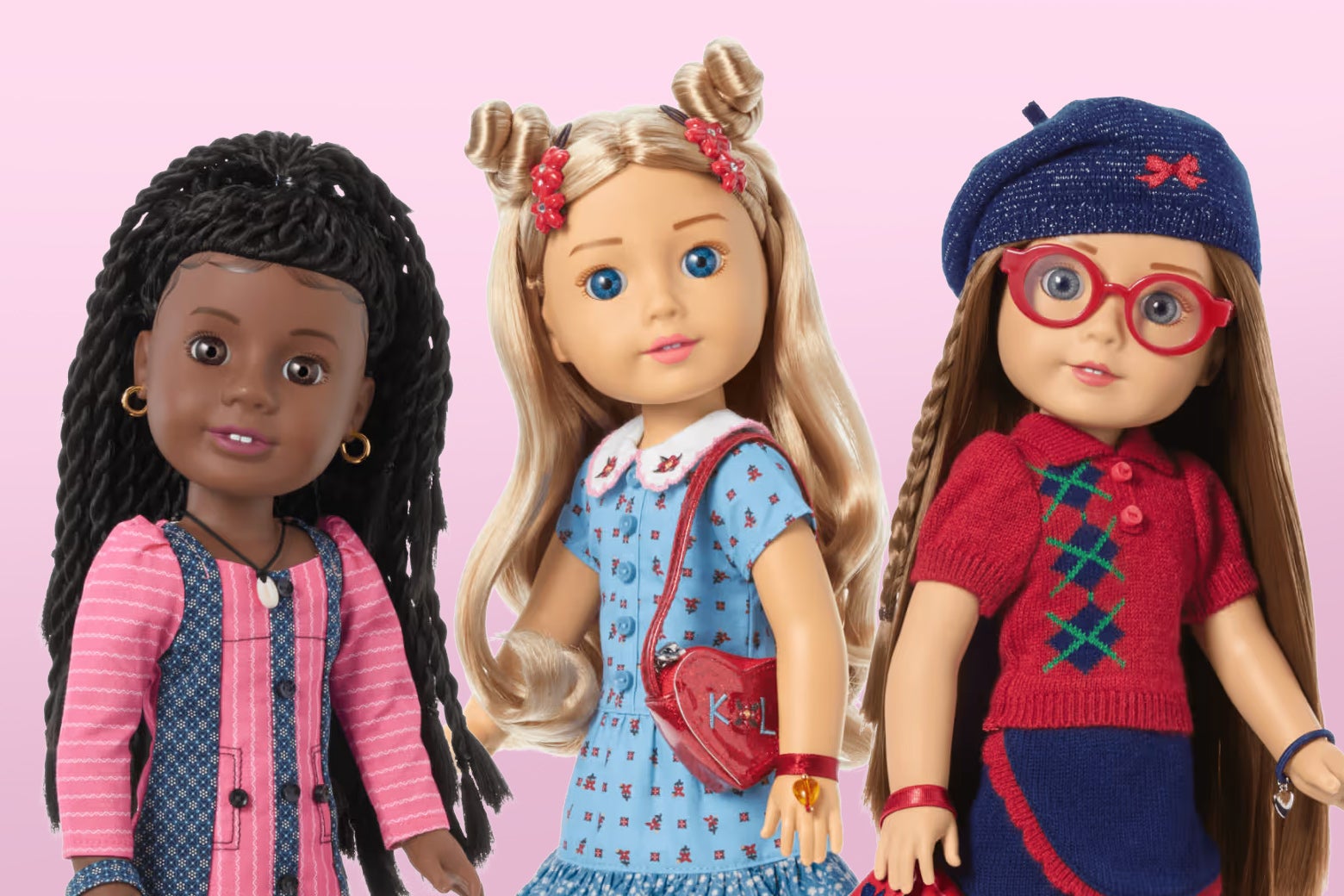
By now you’ve likely seen them: 14.5 inches in height vs. the classic 18; Shein-esque attire that nevertheless incorporates the patterns and fabrics specific to their inspirations; perturbingly vacant eyes, even for dolls. They wear chic cowboy boots rather than historical bonnets, pants instead of petticoats. They retail, almost inexplicably, for $90. (WellieWishers, American Girl’s line aimed at children 4 and up and which originated the 14.5-inch doll-body prototype, currently cost $70.) Backlash has been swift and (largely) predictable, centered primarily on both the physicality of the dolls and a perceived ongoing slight toward the historical line, whose collections have continually shrunk over the years as varying dolls cycle through “retirement” and limited rereleases.
From the start, the brand situates this new lineup separately from its historical predecessors as girls from the “modern era” (a phrase historians will quibble over for hours if allowed) and describes it as a “commemorative collection” that “reimagines favorite characters through a modern style lens.” Each modern doll possesses a handful of Easter eggs that reference their original historical doll’s time period (like era-appropriate calico fabric for Addy’s dress) and individual characteristics. (Modern Era Samantha has a gold heart pendant that is meant to symbolize the original doll’s locket, which held pictures of her dearly departed parents.) These intentional sartorial choices are delightful insider perks for those who understand them, but not knowing the full context of the Modern Era Felicity doll’s red faux-leather horse charm doesn’t diminish her value as a toy. To historical Felicity stans, that bag charm symbolizes her complex character building related to equestrianism. For today’s young consumers, she’s just another horse girl.
If the idiom that all press is good press still holds, Mattel has nothing to worry about. Legacy media—this publication included—has taken seriously American Girl’s continued relevance, devoting column space on a near-weekly basis to the company’s latest releases. “American Girl Is Having a Midlife Crisis,” one Cut headline lamented. Lilah Ramzi, writing for Vogue, considered the “limits of nostalgia.” And the New York Times spoke directly with a representative of the company, who addressed what seems to undergird much of the negative feedback around the release: While adults continue to vocally prefer the historical dolls/dolls of their youth, sales indicate that younger consumers (at whom the brand is officially aimed) prefer contemporary collections. When millennials ask snarkily whom these dolls are for, the answer is simple: today’s children.
Every single article covering the release of the new American Girl line centers on grown-ups and doesn’t give an inch of space to the sentiments of the actual target consumers. So that’s who we interviewed. Although full-fledged adults are flooding American Girl’s Instagram comments with vitriol aimed at Modern Era Kirsten’s space buns, children like 6-year-old Margot, from Indiana, are blissfully offline and enamored with the doll’s “space bumps.” Emma, age 8, from Texas, has several original historical dolls (some inherited from her mother, others gifted by an American Girl–loving grandmother) but was excited by the new modernized dolls. “I think they’re really pretty,” she says. “They have cool hairstyles.” Emma also proudly explained that she has read all of the Kirsten books (she has some at home and borrows others from the school library) and likes that the books have both sad and happy parts. “I really liked the part where Kirsten is brave and saves her little brother from the bear,” she says. Greta, age 7, in North Carolina, appreciates the connections the new dolls have to the historical collection. “Like they can be sisters of the old dolls,” she says.
Margot’s 31-year-old mom was the skeptical one. “When I looked [the dolls] up online, I initially thought they were a cute, modern take on the original dolls, but as I kept scrolling, I found some of them to look bizarre,” she says. “I see what American Girl is trying to do to make AG dolls more attractive to a new generation of girls like my daughter, who did seem excited about the modern dolls, but the historical stories, outfits, and accessories were what drew me to American Girl in the first place when I was her age.”
On their own, the dolls already provide a much-needed outlet for children as they learn to navigate the nuances of being a human in our complex world. For generations, doll play has been encouraged for both modeling and projection; many American schools include dolls (or puppets) as part of their social-emotional wellness programs, as well as pretend play centers where children can “rehearse” and trial new feelings and social interactions. The historical aspects of the original American Girl dolls added another contextual layer to the educational benefits on offer. For many fans of the original generation, the history proved to be profoundly influential and was even a contributing factor in their career choices. In 2016, Colonial Williamsburg coined the term Felicity Generation by posting a photo featuring more than two dozen female employees with their American Girl dolls. One of the attendees at our first book-tour stop told us that she fell in love and pursued a career in journalism due to one Kit Kittredge (while dressed just like her for the event).
The original historical dolls came with an introductory companion novel (famously titled Meet [insert American Girl name here]), which connected to at least half a dozen additional books to make up the character’s full story arc. The modern dolls’ only canonical connection to those ancient texts is through “keepsake packaging with archival illustrations and thoughtful details drawn from” the original character’s story. Alarmingly, fans—and Addy’s original book series author, Connie Porter—noticed almost immediately that in the promotional stills, Modern Addy appears to be standing in front of the fence of the plantation depicted on the 1993 Meet Addy book, tobacco leaves and all. “I would have thought American Girl/Mattel would have had someone sitting at the table who picked up on what it meant to have the modern character still in the tobacco field,” Porter wrote in a public Instagram comment. “No matter what some may say, not only does representation matter, but representation that is informed, intentional and has the power to shape policy and product matters even more.” Thoughtful details, indeed.
At a recent book event in Virginia, a fifth grade teacher shared that her students simply aren’t interested in learning about history these days. Another audience member jokingly traced the current generation’s apathy to a lack of access to the once popular historical computer game The Oregon Trail (in which players can die from myriad diseases, including cholera—notably the same affliction that killed OG Kirsten’s best friend, Marta). Since the early aughts, and after the implementation of No Child Left Behind legislation, elementary schools across the nation largely reprioritized math and reading (paired with numerous standardized tests), leaving little room for history and many other formerly standard aspects of modern core curricula. History is still taught, but in ad hoc and—in some districts—subversive ways. Briannah, a fourth grade public school teacher based in North Carolina, reads historical fiction to her students, explaining that the genre requires additional prior knowledge on her part so she can facilitate “as they decipher the parts of the books that are real and the parts that are designed to support the real.” Briannah says her “current students enjoy learning about history. They are interested to learn how things ‘used to be,’ and history feels like a grown up conversation that they get to be a part of.” Frances, age 10, in North Carolina, also prefers the original historical collection. “I like how they made them modern,” she says, “but I like how the original ones are larger and just, like, the fact that they are historical. I like seeing the way they were, what it was like in 19-something or the 1800s.”
And therein lies the clever crux of American Girl’s latest launch: If history is a grown-up conversation, then these Modern Era dolls are for playful chats—the kind children magically find easy and most of us avoid at all costs. As Mattel is a strategically thinking $4.8 billion toy brand, the fact that these new dolls still have the veneer of their historical predecessors is blatantly intentional. When a child has outgrown her Modern Era American Girl Samantha and feels ready for the trauma of orphanhood and early-20th-century child labor laws, the slightly more grown-up, historically focused (and even more expensive) Samantha Parkington doll is ready for her, along with endless new accessories and clothing options. Purchased separately, of course.