Sign up for the Slatest to get the most insightful analysis, criticism, and advice out there, delivered to your inbox daily.
Do you hear that solemn clang? People on the internet seem to be taking Lindy West’s memoir as millennial feminism’s final death knell.
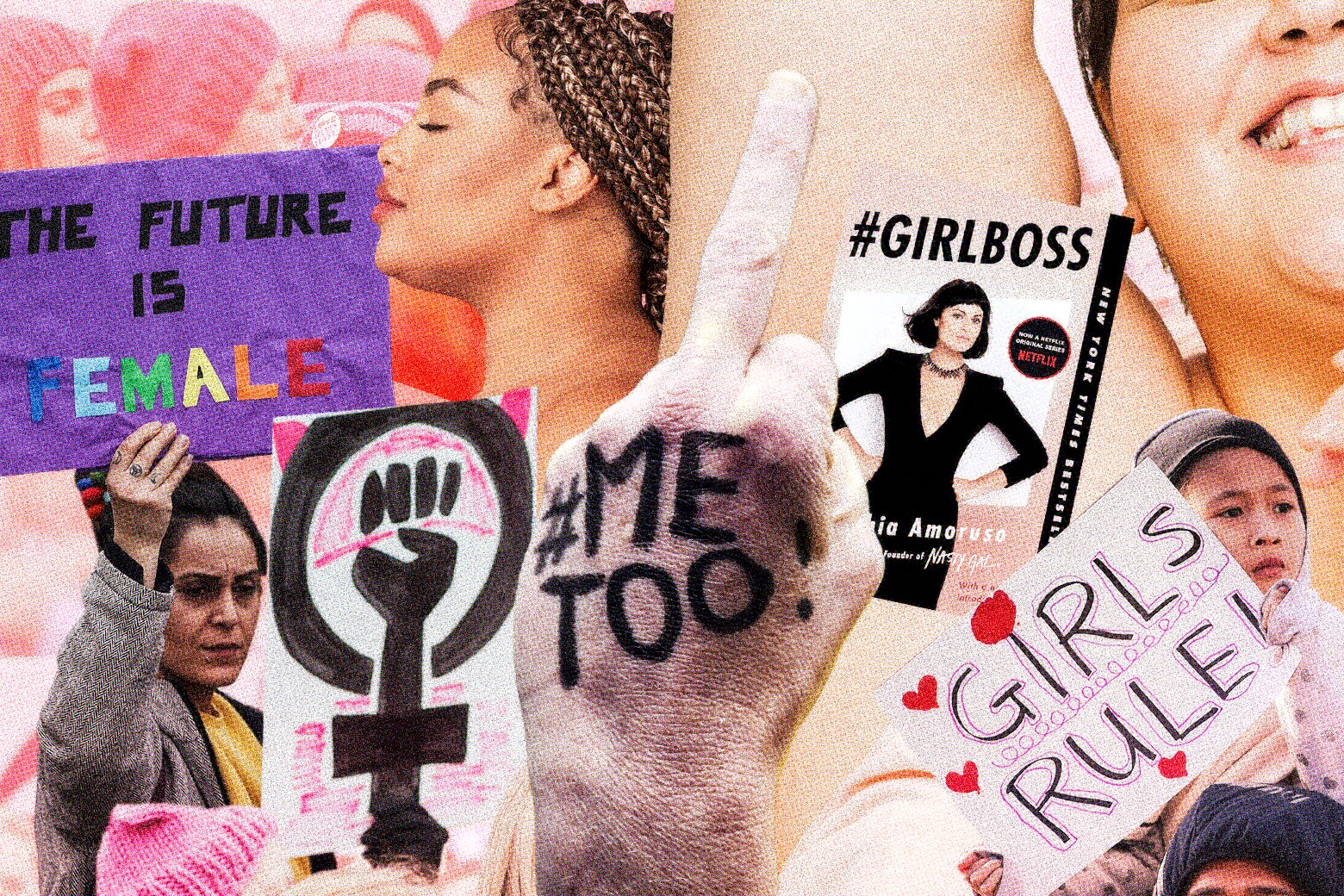
The extremely online 2010s movement—which brought us #MeToo, body positivity, the mainstreaming of intersectionality, and the Girl Boss—was already on death watch with the reelection of accused sexual assailant Donald Trump, the overturning of Roe v. Wade, and the absolutely enormous antifeminist backlash within which we are all living. And there’s a certain irony to the idea that the final tolling of the bell, as detractors tell it, came via the medium so carefully honed by millennial feminists: a personal essay, in this case at book length.
West, one of the grande dames of the movement, got her start at Seattle alt-weekly the Stranger and spent years excoriating fatphobia, online misogyny, and male entitlement for the ur-millennial-feminist site Jezebel. Her new memoir, Adult Braces, is about how her on-its-face happy marriage was actually much more complicated, culminating in West winding up in a polycule she desperately did not want with her husband and one of his several girlfriends—but, plot twist, she has chosen her choice, and she’s happy!
News of millennial feminism’s demise has been met with much applause. It was too censorious. Too glib. Too radical, or perhaps not radical enough. West’s marriage is its microcosm. Millennial feminism, Helen Lewis writes in the Atlantic, eventually revealed “the gap between what its high priestesses demanded and what they were able to endure themselves.” So did West’s memoir. This woman who stood so strongly against male power seems to have been, in the end, felled by it—and now claims that accepting her husband’s demand to open their marriage against her will was progressive, actually.
Feminism is one of history’s most successful social movements, and it is now a century and a half old. Of course millennial feminism was not going to be its permanent state—and that feminism is currently evolving doesn’t mean, as detractors suggest, that the 2010s variety of it was some sort of colossal con or mistake. In fact, most of millennial feminism was pretty great. And when we see what it’s being replaced with, we should be grieving its loss.
When I started writing, around 2003, at a small self-published feminist blog, I had just barely declared myself a feminist. In 2001, during my freshman year of college, a professor asked our Intro to Women’s Studies class—a course I was forced into because I registered late and there was nothing else left—whether we identified as feminists, and I checked the no box. Feminist voices in media were incredibly rare. Katha Pollitt, who wrote a column for the Nation, is honestly the only prominent feminist writer whose name I remember regularly seeing in the pages of newspapers and magazines. Reporting on abortion and women’s health could be found largely in the Style section. Women’s magazines were about how to snag a man. Girls Gone Wild was cool. Everyone laughed at, or pruriently watched, stolen celebrity sex tapes.
It was into the post-noughties misogynist cesspool that the early feminist blogosphere was born, and initially, it was fun and freewheeling. Blog comment sections were notoriously dynamic, full of debate and discussion and lots of light bulb moments for writers and readers alike. For women who were, like me, in their teens or early 20s during this era, it felt as if a veil had been lifted and suddenly, the vastly unequal world around you was in clear focus.
Many of us were the Success Daughters who had grown up hearing that we could be anything we wanted, only to encounter barriers and indignities we hadn’t been told existed. Mansplaining is now a much-mocked term, but it put a name to a real dynamic that I found myself repeatedly stunned to experience. Gaslighting has had its meaning stretched beyond recognition, but men denying women’s realities to manipulate us really is a thing. Everyone hates the Girl Boss, but female founders really were underresourced, and female ambition really was treated with disdain and distrust. (Just ask all the Girl Bosses who eventually found themselves the subjects of vicious takedowns.) The early feminist blogosphere took on everything from the way the media covered women’s health to the way our partners treated us to which tasks our bosses at work assigned us, and how all of that was shaped not only by gender but by race and class. It felt the way I imagine those famous ’70s consciousness-raising sessions must have felt: like simultaneous creation and discovery. It felt as if we were building something bigger than any one of us.
There were many ways in which this movement went wrong, and if you ask 100 participants in it, you’ll get 100 different answers. Many argue (I think correctly) that it quickly replicated the racial inequalities that animate American life and sank previous feminist movements, with young white women getting book deals and speaking opportunities while women of color were ignored or relegated to writing about race alone. Others say that legitimate concerns about racism and racial inequalities metastasized into an unhelpful obsession with racism and intersectionality, which was quickly wielded not in the pursuit of justice but against perceived enemies or to avenge petty jealousies. (Before there was cancel culture, there was, in the feminist blogosphere, “call-out culture.”) Ultimately, too many millennial feminists turned necessary criticisms of power into mechanisms for tearing one another down and, sometimes, for misogyny disguised as radicalism.
The concept of intersectionality was a cornerstone of millennial feminism, which (again, I think correctly) brought in movements for fat acceptance and trans rights. But a creeping censoriousness and the collective norm of publicly shaming and isolating those whose views were “problematic” meant that questions shared by much of the public about what, exactly, it means to be female beyond self-identification or whether it really was possibly to be healthy at every size were shut down; allowing those discussions in your blog’s comment section led to accusations of transphobia, fatphobia, traumatizing readers, and a mass gnashing of teeth. This kind of narrowing of the acceptable realm of conversation may have briefly led to a feeling that once marginalized groups were triumphing. But I suspect that in reality, many people with legitimate questions and concerns simply started to distrust a movement that insists that there’s no such thing as an “unhealthy” food, that having a household budget is a manifestation of fatphobic “diet culture,” or that using medical terminology for women’s body parts or talking about “pregnant women” was exclusionary.
There is, in other words, much to criticize about millennial feminism, and there are many lessons to learn. But homing in on the annoying and self-defeating aspects of it misses the real story of how the movement changed American society, and the world, for the better—and how Lindy West did too.
West didn’t just embody feminist fat acceptance; she made it cool and brought it to the masses. While Christopher Hitchens was arguing that women aren’t funny, there was West, out there being funny, a woman, and a feminist to boot. She co-founded the #ShoutYourAbortion campaign and talked about her own abortion as an unalloyed good, creating a permission structure for other women to do the same. West, a human being, was never going to be anyone’s idea of a perfect feminist (I suspect least of all her own). But her very existence gave a certain kind of young woman a compelling model of how to be a brasher, less apologetic, more feminist person in the world.
The millennial feminist movement also, on balance, did far more good than harm. Take the fight for abortion rights, the feminist movement that has seen the clearest and most devastating losses in the past few years. One might quibble with whether the strategy of “Shout Your Abortion” actually created converts, but Roe was overturned because of the decadeslong brick-by-brick work of the anti-abortion movement, not irreverent Instagram posts. In its wake, we see the results of millennial feminism: an unprecedented lack of shame or apology from women who have had abortions; activists, health workers, and average citizens who are willing to break unjust laws to help women and girls in need; media outlets that cover abortion restrictions and their consequences as serious stories worthy of national attention, not Style section ephemera. Or #MeToo, a national reckoning that simply would not have happened had millennial feminists not profoundly changed the discourse around sex, sexual harassment, and power, and had women and men who came of age in an era of millennial feminism not had jobs at well-resourced national publications.
There were, of course, moments of #MeToo overreach. But from today’s vantage point, it seems obvious that the movement changed society for the far better. Even issues that would go on to be more contentious within feminism and outside it—body positivity, trans rights—did crucial work. The diet culture of the ’90s was never totally vanquished, and Ozempic has complicated narratives about body size, health, and self-love, to put it mildly. But insisting that women have a right to feel happy in our own skin? That skinniness is not the only way to be sexy? That health is more complicated than a number on a scale? These are hugely positive innovations. And while the shutting down of discourse around truly thorny questions of sex and biology and gender and sociology was ultimately self-defeating, majorities of Americans now support laws that protect trans people from discrimination and allow adults to make their own medical decisions—questions that weren’t even being posed by pollsters when I started blogging.
We did not tip into a world of perfect trans rights, nor one of feminist victory. Progress has not been linear. But we have, in the aggregate, moved forward.
Right now we are in a moment of reversal. Women’s rights are being rolled back. Trans rights are being rolled back. The most abjectly misogynistic president of my lifetime is in the White House. And it is also the case that American culture is radically different today from what it was in 2003, when I first pulled up blogspot.com and tried to come up with a catchy name—and by most measures, feminism is far more mainstream than it was two decades ago, and that has been great for women.
The Girl Bosses, the pussy-hatted women at the “Women’s March,” the snarky bloggers and the comment section warriors and Lindy West herself—these were never the whole of millennial feminism. But they were important component parts of it, and in hindsight, they told us something important: that women were showing up, online and off, advocating for themselves and each other. Millennial women, raised on platitudes that one person could change the world, really tried—and some of them, thank the goddesses, succeeded.