Sign up for the Slatest to get the most insightful analysis, criticism, and advice out there, delivered to your inbox daily.
A redacted correspondent, who sounds to be on the younger side of things, emails Jeffrey Epstein to thank him for their “fun” talk. Then the correspondent remarks: “I seldom have the chance to talk to a genetic suprematist.”
I found this message while spending a week with what our Justice Department has dubbed—oddly, for this reader at least—the “Epstein Library.” Otherwise known as the Epstein files, this “library” is laden with crudity, eye-piercing typos, and rants about genetics. And redactions: Whoever exactly, in the above quote, had had fun talking to Epstein appears only as a black bar.
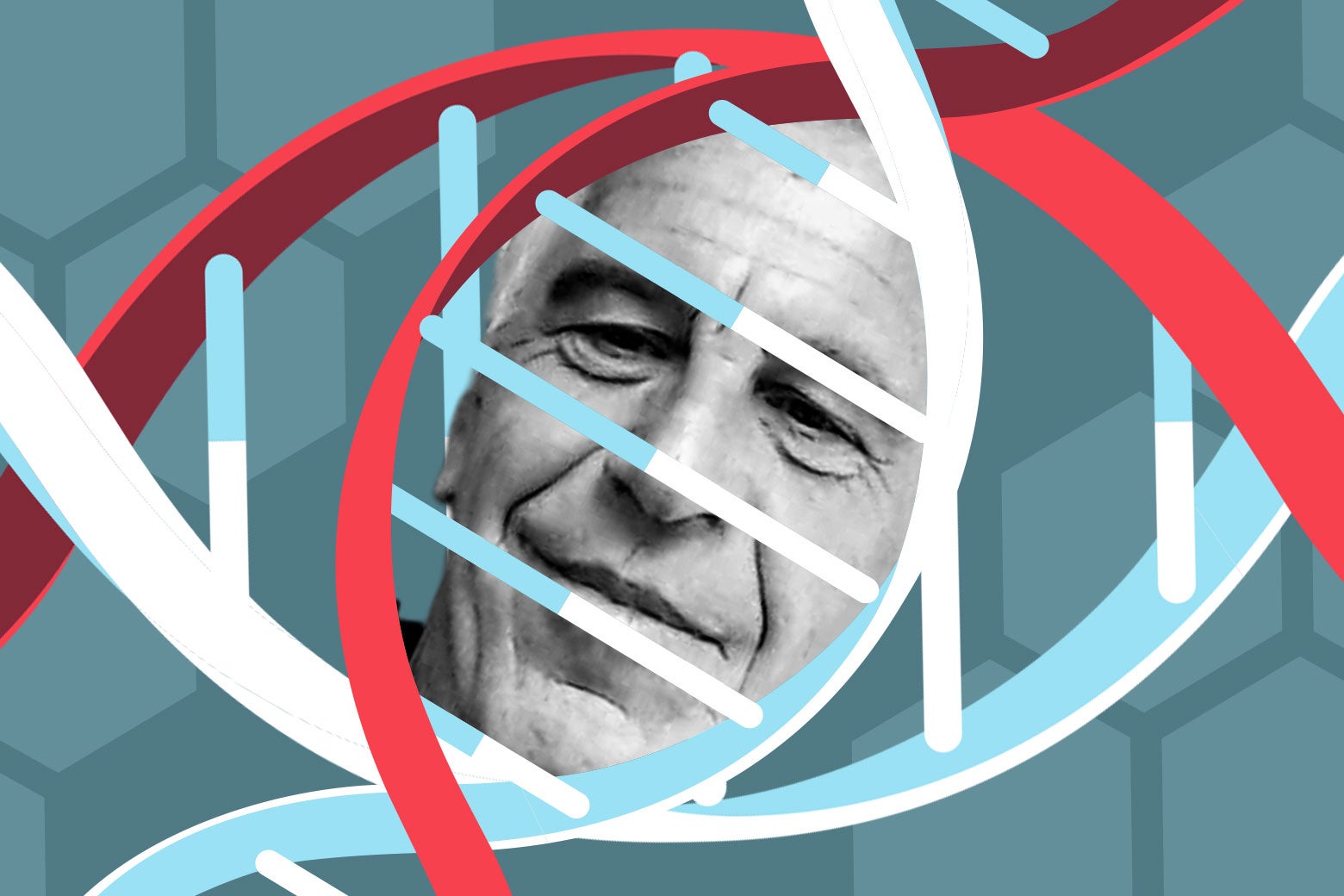
But the phrase genetic supremacist is very apt. A strange part of the strange life of Jeffrey Epstein was his obsession with the genome. And with ways to “improve” that genome—including by adding more of his own genes to humanity’s gene pool.
Epstein, culpable for so much, was also a believer in eugenics, the manipulation of reproduction and of genes to create “better” humans. His focus on genes, as reflected in his correspondence, is remarkable. The files show that Epstein constantly asks if various random traits might be genetic, spends thousands on high-end DNA sequencing for himself, and has his assistants hand out 23andMe test kits the way most people hand out business cards. He even had a kit sent to the Chomskys, who you’d think could manage one on their own.
The term transhumanism has become popular in the 21st century and gets used in connection with Epstein. It refers to ginning up the gene pool through tools like gene editing and A.I. enhancement, the argument being that manipulating genes can make us better, faster, smarter. It amounts to the same thing as eugenics. Epstein’s goals included making “better” humans from some people’s genetic material, addressing traits from intelligence to sex drive, and suppressing that of others—in fact, he writes, “maybe climate change is a good way of dealing with overpopulation.” If economics can be called the dismal science, I’d argue that eugenics might be called the narcissistic one. Journalist Virginia Heffernan, who attended events sponsored by Epstein and his crew of like-minded scientists and the rich, recently described their psychology as “alpha-male minds, and together, over decades, they all converged on a master philosophy: they were apex predators ordained by nature to exploit and subjugate others.”
Though, like many things Epstein, the man’s genetic interests were twisted, often revolting, and shockingly uninformed. He felt about genes the way grade-school kids might feel about Santa—genes are wondrous things, capable of delivering just about anything petitioners may desire. Epstein, in his musings in the files, credits genes with controlling things that range from the rear ends of people of Irish descent to honor killings, financial skill, and, weirdly, “Asian family structure.”
Like so many eugenicists, Epstein believed that factors like race and gender make some humans inherently unequal to others—hence the need for genetic manipulation: “More importantly„ why do women confuse knowing facts with knowledge they are good at trivila pursuit but not theory or laws,” Epstein complains to a correspondent. He laments what he sees as gaps in Black cognition and test scores and discusses with cognitive scientist Joscha Bach how gene editing could make Black people more intelligent. Elsewhere, he wonders whether gene editing can enhance women’s sex drives.
Epstein is hardly the first rich American to pursue the literal eugenic, or “beautiful gene.” It’s a term coined by Charles Darwin’s cousin Francis Galton in 1883, though understanding the structure of the human genome came much later. Galton was largely self-educated, an odd man who studied fingerprints and claimed to have proved through testing that praying doesn’t help matters. In Galton’s day, the impact of heredity on who we are as people had become recognized, then greatly exaggerated—a trend that continued through the next century and remains alive and well today.
I explore eugenics—and millionaires—in my book The Devil’s Castle: Nazi Eugenics, Euthanasia, and How Psychiatry’s Troubled History Reverberates Today. To name just a handful of eugenicist millionaires: The Rockefeller family helped fund the German lab where Josef Mengele began his twin research, searching for the key to inherited traits with the aim of controlling them. The Harriman family supported the Eugenics Record Office in Cold Spring Harbor, New York. And John Harvey Kellogg, of the cereal family, founded his own Race Betterment Foundation, intending to use the tools of animal breeding to create human “thoroughbreds.”
The United States began legalizing coercive sterilization in 1907, for conditions like “feeble-mindedness”—several decades before Germany enacted the same. The U.S. considered the idea of putting “undesirable” populations, like neurodivergent citizens, to death. Nazi Germany would do this, killing hundreds of thousands.
Epstein resembled other eugenics thinkers in believing that the best improvement to the gene pool might be putting more of himself into it: The New York Times in 2019 reported a story on Epstein’s plan, which doesn’t so far seem to have materialized, to breed his own babies at his Santa Fe ranch. He described these ambitions to multiple scientists, envisioning using insemination to impregnate as many as 20 women at a time. Epstein also intended to have parts of himself cryogenically frozen and had connections to a DNA-banking operation.
But genes don’t behave as Epstein imagined they do, like codes punched into a computer—they’re neither blueprints nor instructions, though pop culture often presents them that way. The ease with which genes pass on mechanical, protein-coded traits like eye color has misled even scientists into thinking that they pass on other traits straightforwardly as well. But qualities like family structure, math skills, and trivia come far more from life and environment than from protein structures (which are very good at giving you brown eyes). Genes can be expressed or activated, or not—more often they’re not; they mutate and can alter their own function and be altered by environmental forces. Few have any fixed function. As Philip Ball, who wrote How Life Works, puts it, looking to genes to explain who you are is like staring at the dictionary hoping to understand literature. And imagining you can simply add genes to people and create a specific type of person is like shaking up a box of all the letters used in Hamlet and expecting to create another play just as good. For that matter, Shakespeare had three brothers, who shared much of his DNA. One worked in haberdashery, one acted, and one’s path was uncertain—but none wrote.
What we could call the Epsteinian dark and mechanistic view of genes does offer a theory of human value in which some of us are just born with the right codes—the genetic apex predators. Those of us who get the right coding to only be good at trivia? Hardly worth worrying about. Epidemiologist Abby Lippman dubbed such exaggeration of what genes do “geneticization,” and Ball calls geneticization a “hair’s breadth away from eugenics.” In Epstein’s case, even the hair was lost. He harmed those around him, especially the “trivial” females around him, and ended up filled with self-pity at what his own acts had done to his reputation.
It’s not possible to tie even math skills firmly to genes, much less anyone’s family structure. Epstein fell into a historical trap, one in which “making things better for humanity” quickly slides into “better for me.” And terrible for those around you.
It’s a trap baited ultimately with contempt for other humans. I hope the Epstein case draws attention to this dark genetic path. We have seen what’s down that path, and the new genetic supremacists don’t promise any better.