Of all the pop-cultural impressions of Pennsylvania and its largest city—the sweaty grit of Rocky Balboa; the cash-strapped chutzpah of Abbott Elementary; the boisterous sleaze of It’s Always Sunny in Philadelphia; hell, even the dynasty-shaking upsets of the Philadelphia Eagles—one of the most interesting to emerge has been the profound melancholy of crime shows set in the United States’ fifth most populous state. Dope Thief, set in Philly and Bucks County, uses the region’s ongoing opioid crisis to spin a thriller about grim life on the margins. Long Bright River takes a similar lens, applied to a story about violence against women. Deli Boys, unlike the others, is a comedy, but one with a dark edge about the plight of Pakistani Americans trying to make it in America. And who can forget the extraordinary ache of Mare of Easttown, which put Chester and Delaware Counties on the map for people with HBO accounts?
It’s Mare, as well as other works by creator Brad Ingelsby—the state’s prestige-TV bard—that best exemplify this particular Pennsylvania flavor of rough-and-tumble strangeness drifting into sorrow. Mare of Easttown was acclaimed for its regional specificity and its lead Kate Winslet’s dedication to drab flannel and accent work for authenticity’s sake. This lent the story’s central mystery texture, a richness that crime stories need to feel lived-in and literary. In this world, you know that everyone’s best days are behind them, and how meager those good times were to begin with.
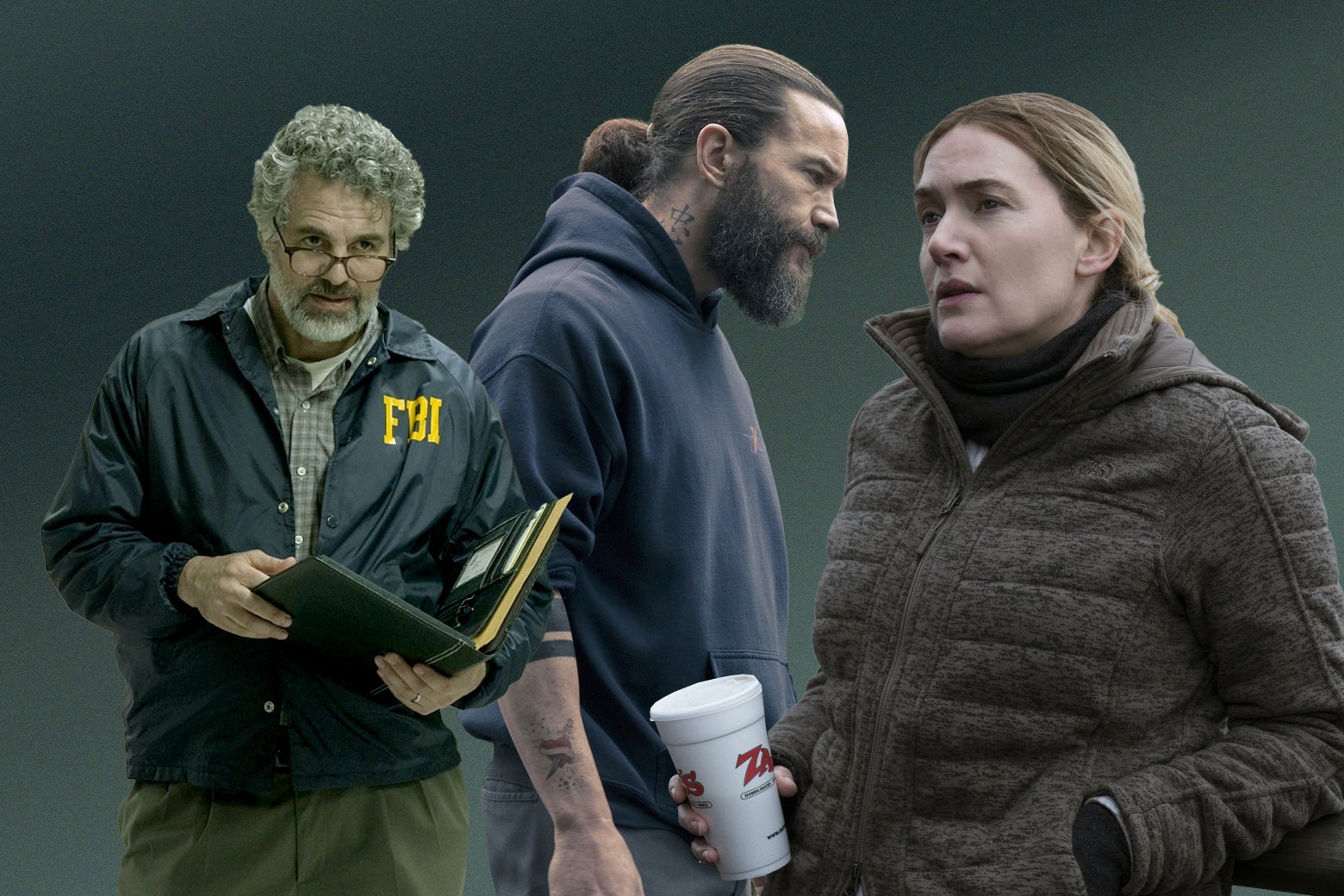
Task, Ingelsby’s follow-up HBO miniseries that premiered in September, rests on similar heartbreak. It spins a parallel tale of Tom Brandis (Mark Ruffalo, gamely frumpy like Winslet before him), a washed-up FBI agent, and Robbie Prendergast (a phenomenal Tom Pelphrey), the crook he’s out to catch. Regional details are once again used to suffuse the sorrow and desperation of both men with a material immediacy: The Pennsylvania locales represented in Task are inelegant tangles of green against tranquil yet indistinct lakes, old houses that seem to have sprouted where they stand, and dingy interiors that accrete the detritus of Wawa orders and unopened mail. Care is taken in accent work that gives conversations the air of economically depressed poetry, tethering exchanges to a place that, despite its rich history and distinct culture, still feels unremarkable and forgotten. Few seem to have any opinion about the place; they are simply there because they always have been, or hope to escape one day. Robbie is an exception—he loves the lake by the quarry. Nearly every character-defining moment or emotional grace note in his story happens alongside the lake that he calls beautiful. Despite all his desperate schemes to get out of here, he might be too of this place to leave it.
Task gives great shape to this idea, and to the onscreen strain of Pennsylvania portrayals marked by loss and disappointment. Look no further than the series’ standout of a fifth episode, “Vagrants.” Tom, getting ahead of his FBI colleagues, attempts to question Robbie without spooking him, but Robbie is wise to it, and takes Tom hostage. On the road together, Tom talks to him about vagrants—birds that have strayed outside of their normal range so far that they can’t find their way home. Most die. This is a transparent play to convince Robbie to turn himself in, to not commit to whatever plan he has for the drugs he’s boosted from the Dark Angel biker gang. But Tom’s bird-watching anecdote can also serve as a metaphor for the cultural anxiety over Pennsylvania more broadly, and its place in the national imagination.
To the liberal-minded audience that HBO shows tend to speak to, Pennsylvania has become symbolic of national heartbreak. A central point of failure in what electoral pundits call the “blue wall” in 2016, the commonwealth has spent much of the past decade as a newly appointed swing state of great prominence, a hotly contested arena that would forecast the next two elections. The peculiarities of American presidential elections and how they are covered made it seem like Pennsylvanians had disproportionate power over the fate of the nation, a cosmic significance underlined by its historical designation as the birthplace of the United States. It’s a strange way to think about a place, reducing a region to a sense of political disquiet. If pop culture provides a crude reading of our collective subconscious, it’s rarely a polite one.
Brad Ingelsby’s HBO oeuvre doesn’t directly evoke any of this, but the feeling permeates his dramas’ elegiac atmospheres. Task, like Mare of Easttown before it, burdens its protagonists with histories of misfortune, dropping viewers into lives years after any promise was snuffed out of them. Tom is a shell of a man, whose wife is dead at the hands of his adopted son, and whose relationships with his remaining children are fractured. Robbie, meanwhile, is a garbage man stripped of his self-worth after his brother dies. Each blames a single traumatic event for their life’s downturn. Each has the power to do something about it; the drama comes from whether they will find the will.
While Task seems to take place largely in a vacuum—with no indication of the sitting president, or the year, or even if the Eagles have won the Super Bowl—the series rests on the viewer’s sympathies for a mostly white, working-class, rural-ish population, the Forgotten Man that Trumpism is built to valorize. A political reading of the show might note that its melancholy, like its regional specificity, invites the viewer to project, to see the country they wish to in its garbage-truck drivers and kids scooping water ice. Seeing these figures and their desolation, you think about so-called Real America. It’s the Kuleshov effect, applied to an entire state.
There are no neat resolutions in shows like this. People get the opportunity to contemplate change, but the credits always roll before we see anyone commit to that change. We’ll never know how it works out—just that, as Robbie asserts, “there’s nothing after this.” Hence the anxiety made palpable in the Delaware Valley: Are these people all vagrants, too far gone to know their way back? Maybe that’s the implication beneath the sorrow we see painted across these stories of loss and crime in Pennsylvania. “I never once felt God in my life,” Robbie tells Tom on that drive. “I think people want to believe there’s more than this, because if this is really all there is, then that’s too fuckin’ depressing.” In this version of Pennsylvania, that’s all there really is. A place to live your only life.