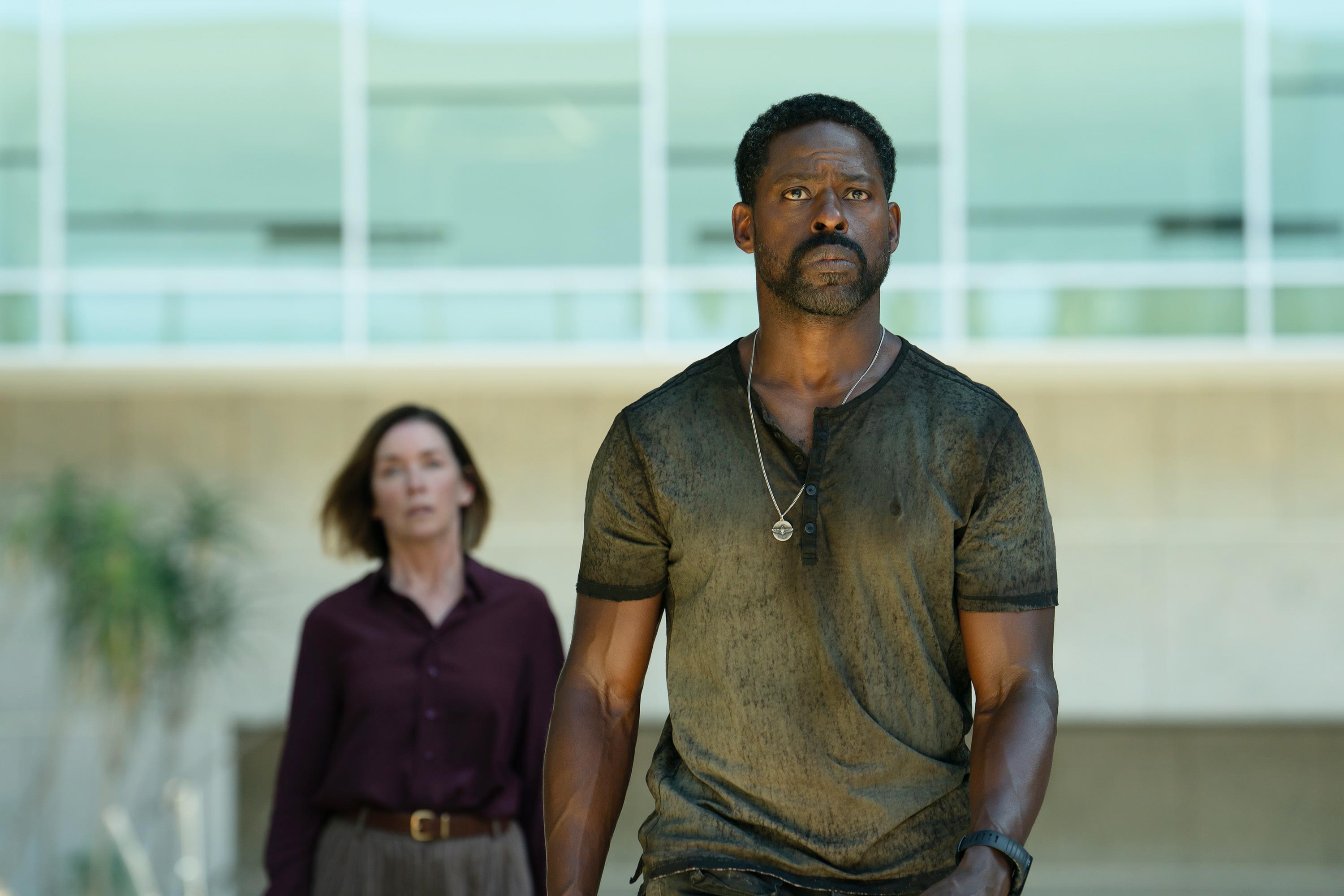
Hulu’s surprise hit series Paradise is one of the trickiest on television. It’s a true kitchen-sink show; there is nothing that creator Dan Fogelman and his writing team will not throw into the mix. Its first season, which premiered last January, changed shape constantly, moving from murder mystery to postapocalyptic thriller to family drama and back. As such, it was a bit hard to nail down, but ultimately—and perhaps inadvertently—became a compelling portrait of the United States’ troubling reliance on the whims of tech oligarchs to fuel progress and avert disaster.
In its second season, which concluded this week, Paradise has shifted yet again. A new season-long mystery has been introduced, one revolving around the identity of “Alex”—revealed in Monday’s finale to be a quantum supercomputer with the ability to predict the future and tamper with time. This has moved Paradise, which was already set in a near-future world plunged into darkness following climate collapse, firmly into science-fiction territory, with outright time travel or manipulation on the table. Thematically, however, the show is moving in strictly one direction: backward.
There are two ways to take Paradise’s genre provocations. You can treat them as sugar for the pill, an arresting way to seize the attention of a fractured audience with an abundance of choice in the service of getting them in front of what Paradise actually spends the majority of its episodes exploring: treacly, fuzzy treatises on connection and family. (More on this soon.) Or you can consider them a vital part of the show’s project, at which point the sci-fi plot is kind of concerning in the sort of fantasy it indulges in, which is the liberal wish fulfillment of undoing the past 10 years of U.S. sociopolitical upheaval.
This is not a Reddit-pilled fan theory, but the text of the show itself. In Paradise, the most powerful and morally complicated character is Samantha “Sinatra” Redmond (Julianne Nicholson), the tech billionaire responsible for building the eponymous bunker-village for 25,000 lucky people to ride out the climate apocalypse in. In the first season, we learn her streak of ruthless semi-altruism is attributed to the loss of her son, Dylan, to chronic illness. In the second season, Sinatra’s efforts are revealed to be even more involved than previously known, funding the development of said quantum computer, which—unbeknownst to her—appears to have brought her son back in the present day, a grown adult on a mysterious mission of his own.
The specifics of the sci-fi thriller twists and turns are irrelevant. The Alex supercomputer is clearly meant to be a giant metaphysical reset button, either undoing the apocalypse or making it better. And the season ends with the show’s protagonist, former Secret Service Agent Xavier Collins (Sterling K. Brown), on a mission to give that button a push. This is kind of silly on its face, a literal deus ex machina for Paradise’s world of woe. But it’s also regressive in a way that reflects a lot of liberal thinking on the real-world woes that Paradise presents itself as a salve to, with many of the series’ conflicts coming to a head over whether two diametrically opposed parties can hug it out.
This sort of thinking feels familiar. After a decade of MAGA and all it has wrought, there is nothing that establishment liberals seem to want more than to just go back to how things were before. You can see this everywhere, in Democrat 2028 hopefuls campaigning on affordability, in the same party’s response to war in Iran overwhelmingly defaulting to procedural heckles, how op-eds push for moderation and grace from Democrats when they win control back from score-settling Republicans. There is an imagined baseline to our politics that we have strayed from, this belief holds, and if we can just find our way back to it, all will be well.
It is an unserious rationale, pretending that material ground has not been lost for innumerable U.S. citizens: in Supreme Court decisions, in the Department of Government Efficiency’s shredding of federal agencies, in Immigration and Customs Enforcement overreach. Decades of progress in public life have been swept away as a result, and we’ll be lucky to claw any of it back—including whatever meager steps we had taken to prevent the sort of climate apocalypse Paradise is predicated on. (Again, there is a cogent reason why the show’s bunker-town is developed by a tech billionaire rather than a government agency.)
Perhaps this is a lot to put on a TV show whose primary purpose is, above all, to entertain. Perhaps Paradise’s writers—who already have a green light for a third season—have a canny way to address this exact criticism. There’s certainly room for it, as any story about hitting a big reset button for the world could easily become a story about why one shouldn’t hit a big reset button.
This yearning for a vague sense of before, however, is also present even when Paradise is not pursuing its big silly sci-fi plot. The bulk of Paradise, after all, comprises tender stories about how we reconnect with each other’s fundamental humanity after the end of a divisive world order. It’s a nice sentiment—but here, that connection is almost entirely explored through the success or failure of traditional nuclear families, hewing to a conventionality that feels almost reactionary at times.
Once you notice this about the show, you see it in every scene. Every hope that Paradise has is in a family being born or reunited, while every despair comes from a family ruptured or lost. Xavier Collins is our hero because he lives not just for his family, but also for the idea of family. Parenting, he tells the pregnant Annie Clay (Shailene Woodley), is “a holy charge,” and meeting your child is one of the few moments that you get to experience “life at full volume.” Sinatra, on the other hand, is clearly compromised in her moral standing, her overreach fueled by the loss of her son. Jane Driscoll (Nicole Brydon Bloom), Sinatra’s bodyguard/hitwoman, is set on the path of a hardened killer after she is denied her mother’s love as a child. Even Alex, the quantum supercomputer that may save the world, can’t escape the cloy of family; it’s named after the wife of inventor Henry Miller (Patrick Fischler), who is slowly dying from Huntington’s disease.
These families are traditional in their composition almost to a one: man, wife, children. All straight and cis. There are interracial relationships and flexible gender roles, but if there are queer or trans people in this future, then they are but a suggestion, and do not possess the hands with which the future of Paradise will be built. Found families, the most beloved of TV units, are just temporary arrangements for people searching for a Real Family. This too has an echo in the weak-kneed liberalism of mainstream Democrat politicians, happy to cede the welfare of trans citizens in exchange for appearing “culturally normal,” as Gavin Newsom said. The ongoing gender panic, much like the immigration panic, or the college campus panic, or any of the various fronts in the endless culture war post-Trump, seeks to assert increasingly narrow definitions of normalcy, and then question the legitimacy of whatever falls outside of it.
Is Paradise a part of this project? Probably not. For all the series’ faults, it feels sincere in its efforts to offer some kind of antidote, genuine in the desire to provide a means by which people can be inspired to seek common ground with one another—which might explain, in part, why the show has garnered such dedicated fans. It is also, however, undercut by something frustratingly common to liberal idealism, an attitude that contributed to Trump’s first victory and every Democrat’s loss since: a refusal to contend with the notion that some are simply opposed to the existence of others, to their full participation in public life, and that any compromise with them will ultimately demand you regard someone else as lesser in some way. As such, it is deeply frustrating to see a show that is brave in other ways—certainly brave enough to be whatever kind of story it wants to be each week—resort time and time again to the kind of hacky magical thinking that brought the world crashing down in the first place.