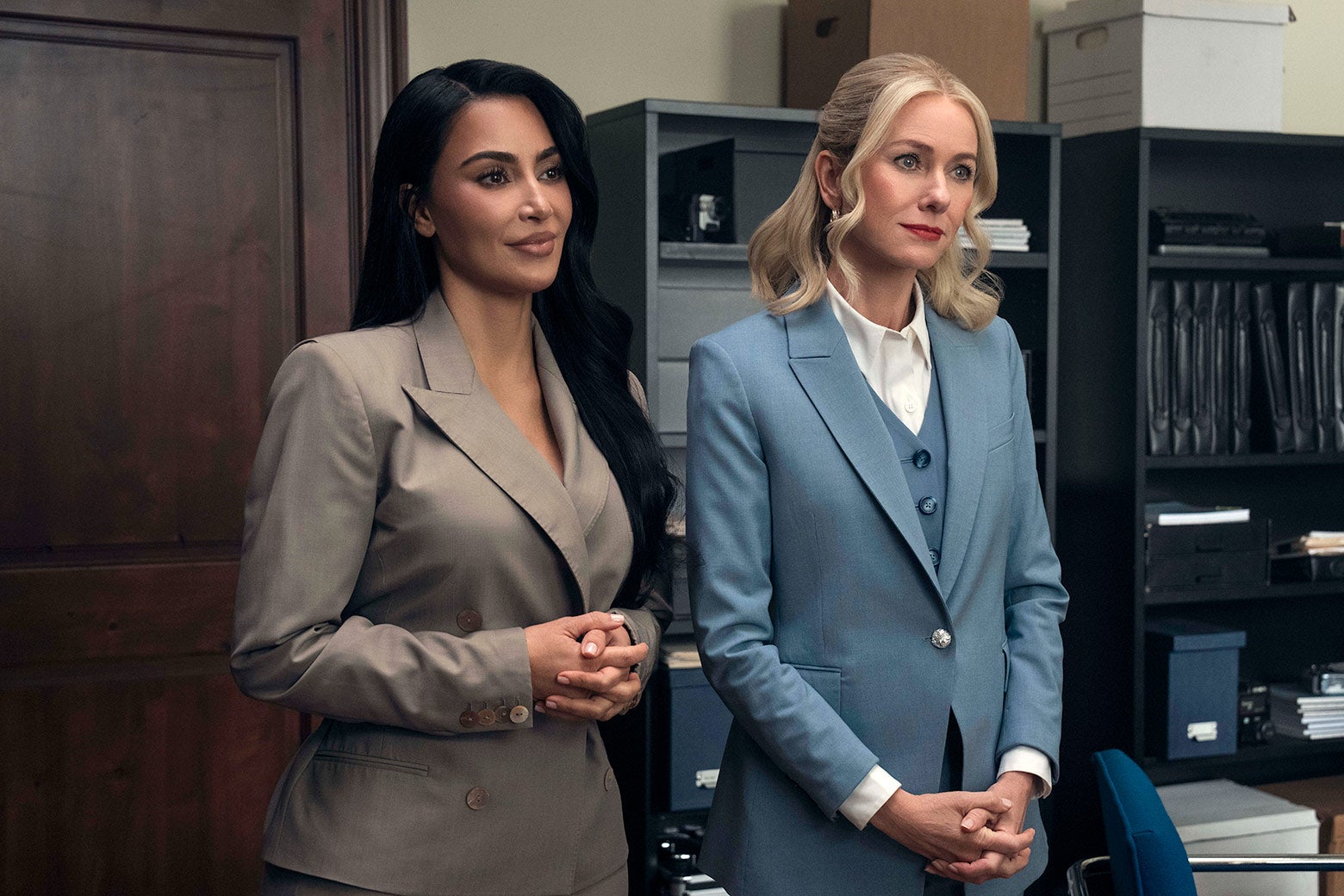
While watching All’s Fair, Hulu’s new star-studded legal drama that has drawn some of the worst reviews for any show since the invention of television, an idle thought may enter what’s left of your brain, as it did mine: What does Ryan Murphy have on these women? The prolific Hollywood producer somehow managed to enlist (blackmail?) Glenn Close, Naomi Watts, Niecy Nash, Sarah Paulson, Teyana Taylor, and, of course, Kim Kardashian into the cast for this series about an all-women law firm helping their all-women clients navigate separations, sex, and scandal. I use the word “cast” loosely—in most of the episodes, the acting is minimal enough that it’s fair to say that all we are really watching is sets of sentient designer clothes holding up Champagne flutes and talking about plastic surgery or vibrators. The series, which premiered on Nov. 4, consists mostly of montages of jewelry-clad women getting in or out of expensive cars or private jets, or being handed (more) Champagne flutes while saying things like “So she just jumped [out the window]?” right as you wish you could do the same.
I consider myself something of a televisual air-crash investigator. I have a forensic eye for what can make a bad show so uniquely bad. Some are bad because they treat beloved characters with confusing disdain, for example; others, because they mete out that same treatment to their audience. Some bad shows get better; others do the same—but then get worse again. Some bad shows are almost good expressly because they come to embrace how bad they are. And then there’s All’s Fair, a show so unique in its badness that I had time to stop, reflect on the professional choices I’ve made in my life that led me to marathoning all four episodes in the series so far, and wonder, How did I end up here?
This may be the first show in history to have a dedicated Champagne budget. It may be the first show to be filmed entirely through an Instagram filter. This is definitely the first show in which Paulson has uttered lines like, “You may think I’m being a greedy little pig-bottom,” and “See you in court, cuntburger!” It’s also the first show in which Kardashian has served as the lead actor, delivering lines as divorce lawyer Allura Grant with all the emotion and cadence of a piece of drywall. “Business is how I unwind,” she says as if she were a haunted doll experiencing life for the first time.
And yet, for all the hatred from critics (whose scorn initially earned the show a rare zero percent rating on the aggregator site Rotten Tomatoes, before the series gasped its way to its current 4 percent), All’s Fair has actually been a ratings winner for Hulu. It enjoyed more than 3 million views in its first three days of streaming—perhaps thanks, in part, to its abysmal early reviews—making it the platform’s most-watched scripted series premiere in three years. This result was framed by some as “a clear division between viewers and critics,” another data point in the apparent declining cultural power that reviewers once enjoyed. The BBC even declared the show to be a “future camp classic,” a designation so outrageous that it feels like it should be among the reasons two top BBC leaders were forced to recently resign.
Let’s be clear: All’s Fair is not a camp classic. For a show to be camp (per Susan Sontag’s definitive 1964 treatise on the subject), it must first aspire to be good to begin with. But nothing about All’s Fair suggests that anyone involved in its cursed creation remotely gave a shit about the finished product. If anything, it aspires openly to badness. This is a show that will take any opportunity to zoom in clumsily on the logos of a Bentley sportscar or Chanel handbag—a show that heard the random, needlessly dramatic soundtrack from Keeping Up With the Kardashians and dared to ask, What if we stretched this music out over a 42-minute episode of scripted drama? It is the logical endpoint for the age of streaming slop: a lazy, ludicrous series with no pretense that it contains anything of value beyond its wardrobe budget and the sky-high salaries it surely paid its stars. Rubbernecking audiences tuning in because they read the scathing reviews and want to watch a car crash are only going to discover that watching someone crash a car on purpose isn’t as much fun as you might think.
As All’s Fair starts, we’re introduced to a group of women each presumably named by an A.I. prompt for “girlboss characters.” There’s Kardashian’s Grant, the Don Draper of divorce lawyers, whose inexplicable skill has helped her start a new firm and bagged her a sexy athlete husband who gifts her diamond rings that once belonged to Elizabeth Taylor, even if he admits he has no idea who that is. There’s her friend and partner Liberty Ronson, an English attorney played by Watts, who somehow struggles to pull off a British accent despite being born there, as she exclaims things like, “From cocktails to cock rings in one 24-hour period! God, I love my job!” Together with investigator Emerald Greene (Nash, never seen without a hat on), they started a women-only firm 10 years ago with the blessing of their icy mentor, Dina Standish (Close), to escape the sexism of their male colleagues. They chose not to take with them Carrington Lane (Paulson) because she is something of a bitch, which sparked her decade-long vendetta against the women. That is, admittedly, a rather bitchy thing to do.
Despite never actually seeing any of these women in the courtroom, we are repeatedly told they are among the greatest lawyers of their age. As evidence for this, we see Ronson deliver sharp legal insights to awestruck clients, like how jewelry gifted to a spouse during a marriage becomes property of that spouse. (Someone get her on the Supreme Court, stat!) Not a work meeting goes by where these women aren’t clutching a glass of bubbly or staring at a plate of haute cuisine that is rarely being eaten, as they scheme about how they can secure $200 million divorce settlements by blackmailing their clients’ exes. The list of guest stars playing these clients reads like a gay man’s fever dream—Jessica Simpson! Elizabeth Berkley! Jennifer Jason Leigh! Judith Light!—but none of them get to do much more than act as depressed as the audience no doubt feels watching all this. Not to worry! Their cases are easily solved in a matter of minutes and it’s time for another glass of “victory fizz!”
Kardashian’s enormous social media following and celebrity clout have surely helped lift All’s Fair’s ratings, so it’s only fair that we zoom in on her performance, specifically. (Who better than her to front a show that’s proof that all publicity is ultimately good publicity?) To call her wooden would be an insult to Pinocchio. For example, when Grant’s marriage implodes due to her sex-addict husband’s repeated infidelities, you’d be forgiven for expecting her to display shock, sadness, or anger—any emotion, really, that might suggest she knows what emotions are. Instead, we see her only vacantly dream of bashing in the car of one of his mistresses, as she is presumably too busy dreaming up what insane thing she will wear next. Clothes, after all, comprise about 95 percent of Grant’s entire personality. In one scene, she attends a meeting with opposing counsel while wearing a pair of pants with a cutout over her ass that shows off her thong. In another, she wears a leather beret, suspenders, and a black tie as if she were a member of the Black Panthers working a catering shift. She also never repeats a hairstyle in any two scenes. Sometimes, she sports wavy tresses that make her look like an Old Hollywood movie star. At other times, she’s got a perky shoulder-length number that makes her look like her mother (and co-executive producer on All’s Fair) Kris Jenner.
After concluding my watch and emerging from a fugue state feeling like that guy in A Clockwork Orange, I had to wonder whether I was being exceptionally harsh on All’s Fair. Why, for example, was I ultimately charmed by the vapid smooth-brainedness of Emily in Paris, but so turned off by this new show’s idiocy? All I can say is that spending time with the former feels like indulging in some sickly-sweet French patisserie meant to be enjoyed in small portions, while consuming the latter left me with an ungodly Champagne hangover that made me want to barf. One is escapism. The other is something you want to escape from. Having finally made it free, I now genuinely want to sue someone. If only I knew some good lawyers.