Sixteenish years ago, the only really bad thing that ever happened in my life happened: My son died at 34 days old. My wife, Carrie, and I were obliterated. His name is (sometimes I say “was,” who knows) Fisher. Luckily, Fisher’s twin brother Truman lived. Caring for him required setting ourselves in motion, kicking ourselves down the huge hill that is first-time parenting. Even though we grieved, wept, wailed, and cursed our fate, we did so while careening through feedings, diaper changes, and all the other hullabaloo. Truman pulled us forward, maybe saving our lives. Who knows what it would have been like if we had sat purposeless on top of each other without him, growing depression on ourselves like mold on strawberries you forgot in the fridge.
The rain kept raining, the L train—our Brooklyn subway—kept squealing, the Mexican guys kept playing volleyball in the park by our house. Truman did not care how sad we were; his needs were primal, ancestral. Cry if you want, Dad. Somebody’s gotta wipe my butt. The world sent the same message, less adorably: We are all moving on, you should too.
Eventually, our lives became a kind of normal. It seemed possible that we were actually OK. We for sure had our moments of doubling over in sudden anguish, but we laughed and we hugged and we survived as well as we could. My boss had been very understanding of the shit situation I was in, but eventually I went back to my work as a high-end tutor. I spent a good part of my days with other people’s kids. Years passed. We had a daughter, Willa, who is perfect.
The thing about grief, for me (I am careful not to universalize, even if I think maybe I could!), is that it never goes away. It never “gets better,” exactly. Nothing helps. “Helps.” Grief moves.
Somewhere in there, I saw my wife’s friend Christy do an improv show at the Upright Citizens Brigade and thought it was the coolest, funniest thing I’d ever seen. I’d gone to college for musical theater (the curse of supportive parents!) but washed out quickly due to a confluence of causes, the leading one being that I was not very good. But the desire to perform, dormant for years, rose up. I started taking classes.
Improv was a haven during the worst times. Consumed by listening, my mind was too full for misery to elbow its way in. And the laughter, the applause? While I was onstage, I was a thousand miles away from sorrow. I was the hot, emanating center of a galaxy of joy. (Don’t fact-check me! In my memory I was extremely good!)
(If sometimes you are in the back of a cab and the driver tells you about his newborn son and you start crying, this is OK, this is normal.)
Is it hard to imagine, a guy with a dead son, playing Zip Zap Zop in a basement underneath a grocery store? Asking for a suggestion, someone says “trombone,” and then he and seven acquaintances start playing invisible instruments, all while a ghost hovers above him? Isn’t it stupid? Absolutely very much, maybe. But it made me feel good. And if there’s one thing I would say, if you want advice, it’s that it is no honor to anyone for you to circumscribe your life for what anyone else might think grief should look like. I don’t mean to abandon your responsibilities; I mean don’t abandon yourself just because you’re supposed to be sad.
Years passed. Eventually, someone who saw me in an improv show offered me a silly amount of money to try doing stand-up. I jumped at it and I crushed. I was hooked on two kinds of comedy.
(You and your wife see Hamilton and wail so hard you lose your breath. You worry you’re ruining it for the people around you. It’s OK, this is normal.)
Somewhere in there, my wife went back to school to become a nurse. I was making enough money tutoring that we could afford her schooling, my comedy, and the retinue of babysitters my late-night wannabe-stand-up life required while she was (at first) taking classes and eventually working overnight shifts in pediatric intensive care. When the kids went to bed, I was loose in the city, trying to win the approval of audiences and other comedians. Actually, it wasn’t too hard. I was funny. I wasn’t good. But for the first couple of years of stand-up, at least, I didn’t know the difference.
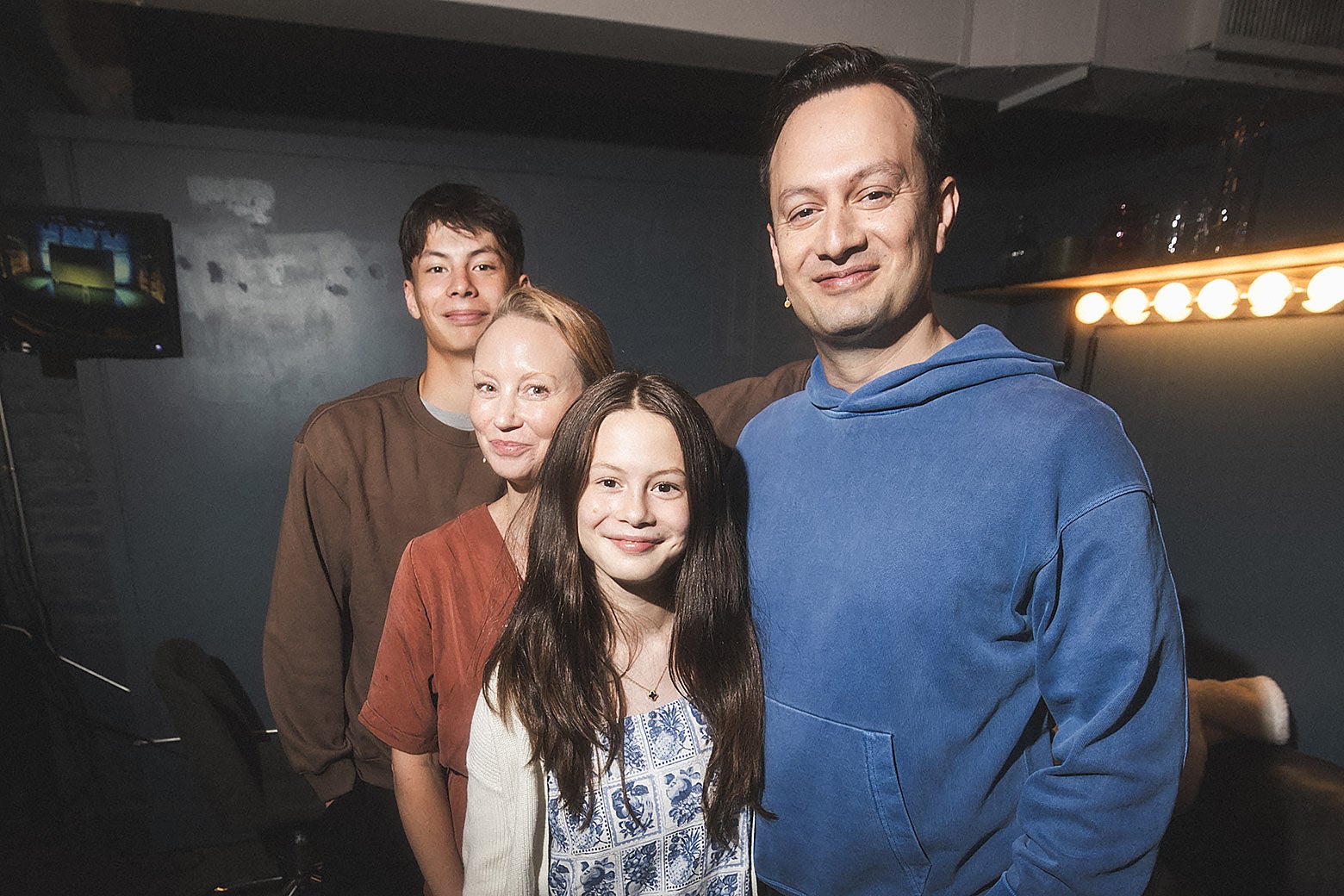
While both tutoring and comedy were easy, even when they were hard, nursing was fucking brutal pretty much all the time. Carrie worked when any reasonable person would be asleep. She watched over children who needed her to stay alive. She would come home at 8 a.m. and plop into bed, drained. She would never say this herself, but she was (is!) an excellent nurse. She would regularly come home with little certificates awarded to her because of some unsolicited feedback. “We couldn’t believe how lucky we were to have Carrie as our nurse,” etc. During COVID she changed her clothes three times a day to keep us safe from whatever was lurking at the hospital. I made her food to take on her way, I tried (poorly) to keep the house from falling completely into squalor while she worked. Her job had such meaning, for her and by extension, for the rest of us.
(From time to time, you can free-associate your way back to extreme sadness. You see a leaf, the leaf reminds you of a salad, you ate a salad at the hospital, Fisher died in a hospital. You are outside a mall in Indianapolis. It happens.)
Comedy, meanwhile, felt hollow. I chased the high of laughter, but never felt sustained by it. I started to get a little notice from The Industry. I screen-tested for Saturday Night Live, I got a set on Late Night With Seth Meyers. I got a dream job writing at The Late Show With Stephen Colbert. I was getting close to something, even if I had no idea what it was, or could be. Simultaneously, I found myself more and more frequently outside myself during my sets. Telling a series of jokes about pornography, I would be standing above myself, watching myself do bits that were killing (sorry, they were) but whispering in my own ear: “Who cares about this?” Increasingly, I found myself thinking about Fisher onstage. It went from some of the time to half the time to all the time.
I didn’t dare talk about it at comedy shows. After all, to my mind, there was nothing less relatable than grief. Especially the grief of losing a child. Had this ever happened to anyone before? No, right? When a friend asked me backstage how the twins were doing and I said, “Oh, god, I’m so sorry to tell you this, but one of them died,” I pretty well learned that most people weren’t ready for candor. Poor guy, his face turned white, like when someone realizes they’re about to throw up.
But the thoughts persisted.
I had always written about Fisher. In a journal, in a blog, scribbling his name on the wall of the theater where I was doing stand-up. On the 10-year anniversary of his death, I turned to Twitter. “This is about grief,” the lengthy thread began. I closed my laptop and went to bed. When I woke up, there were thousands of responses, people of every type pouring out their misery. This person’s daughter, this person’s best friend, this person’s husband, all of them had died. And, contrary to my previous (and subsequent) experience on Twitter (mostly terrible), the comments were uniformly supportive. Many people even expressed gratitude for the conversation. I was overcome by the possibility of community. Maybe I had been wrong. Maybe there were some people who wanted to talk about the worst thing that could happen.
I first tested that theory at the Asian Comedy Fest in 2020, where producers Ed Pokropski and Kate Moran offered me 45 minutes to do “whatever” I wanted. I spoke extemporaneously about my dead son for 45 minutes, to a room full of mostly bewildered people. It was terrible, rarely funny, and hardly thoughtful. But for the first time in a long while, what I said meant something to me. I took what worked (practically nothing) and brought it forward to the next show. And again. And again. During COVID it was livestreamed from an empty basement on the Lower East Side to a nonprofit in North Dakota. The next year it sold out shows in Pittsburgh and L.A. Gradually, it amassed a small following and had gotten to be at least a little bit good.
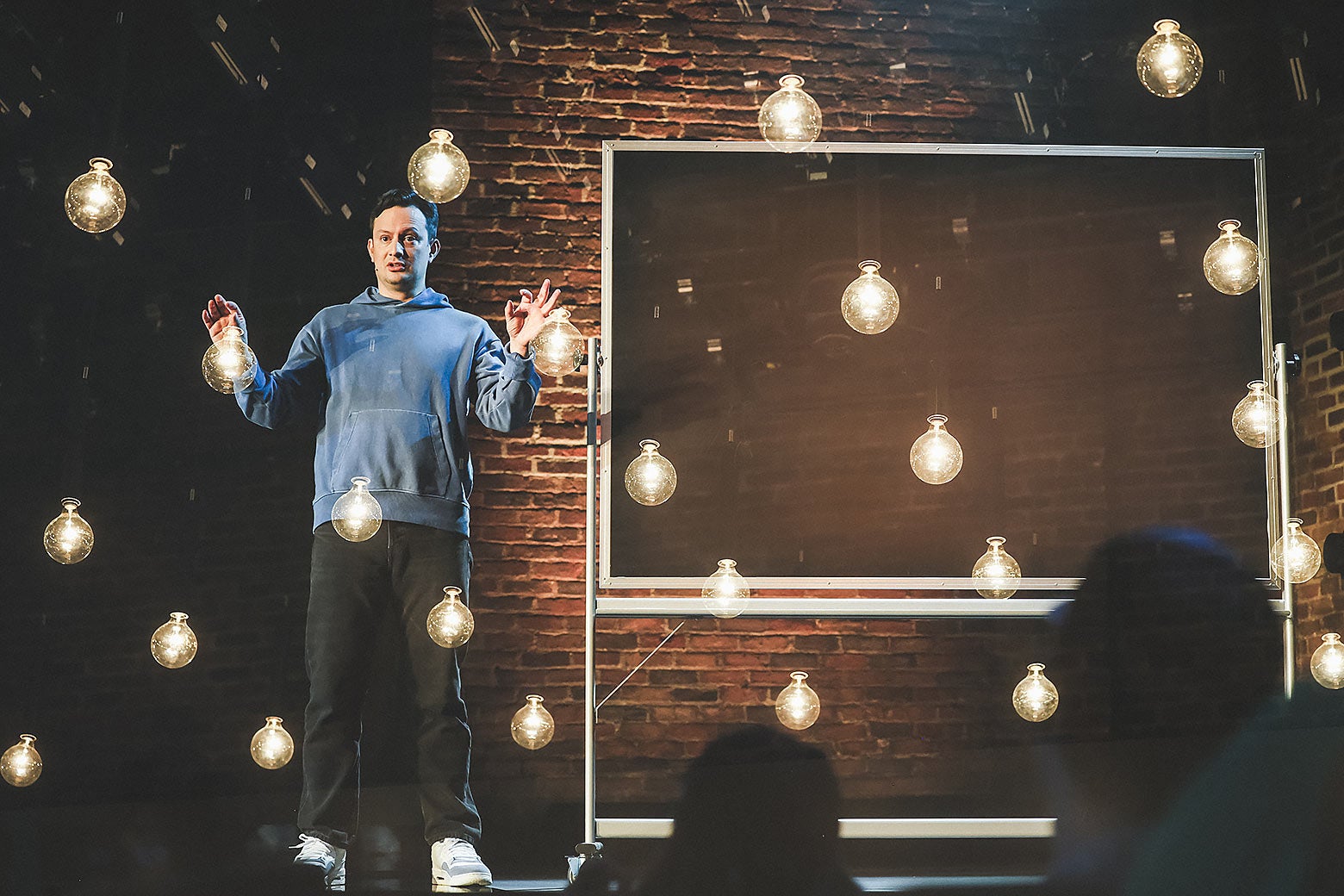
When a director friend brought the head of Audible Theater to see the show—eventually named Sorry for Your Loss—she offered to produce it for a six-week run at the Minetta Lane Theatre in Manhattan. I tapped another friend to direct it. It became the most beautiful thing I’ve ever been near in my entire creative life. Our run was extended to eight weeks.
After Sorry for Your Loss closed off-Broadway, it was released on Audible. It was nominated for a bunch of theater awards. I started touring it more in earnest. It played in Chicago, sold out the Kennedy Center, and returned to L.A., where some lovely people who make stuff for Dropout, the comedy streaming service, caught it. Weeks later, Dropout made an offer to film and stream it. (You can watch it starting today.)
While I was working on the show, I became a student of grief. I started a podcast (I’m sorry!), I read books (brag!), I talked to other grievers, with whom I found a common language that the pre-bereaved do not speak (no shade—I love the griefless!). I opened myself up to the possibilities of the unseen, the not understood. When I learned about particle/wave duality in my reading, I wondered if it could apply to how I now thought of death: We are particles but (and!) also waves. We are both how we see ourselves and how we could never see ourselves. Does that make sense? It does to me, now. I asked a physicist and he said, “Sure, if you want,” and I’m running with that. Do you want to talk about the many things we are, simultaneously? Look me up, I’m into it.
Imbuing the things you do with meaning could change your whole life. I am careful not to say “finding” meaning. Take the thing you’re already doing, and jam the meaning right in there. It helped me immensely. Not by taking away my grief, but by bringing me closer to it, inside of it. Now, 16 years away from my son’s death, the occasional sadness that rises up is no longer intolerable. It’s a remembrance of someone I love, who is in many, many ways still alive.
Sorry for Your Loss is available on Dropout.