
Sign up for the Slatest to get the most insightful analysis, criticism, and advice out there, delivered to your inbox daily.
When I started to listen to the much-hyped new podcast from Katie Miller, I’d hoped to learn something, anything, to justify the many irreplaceable hours of my life I had already committed to it. I wanted a salacious tidbit or quote from one of the nearly 20 episodes that have dropped since August. I wanted moments that might help me understand the kind of person who would be married to Stephen Miller, the White House deputy chief of staff and architect of many of the Trump administration’s harshest and darkest policies.
I did not get any of these things. The podcast, I’m afraid, is eye-wateringly boring—void of a single revelatory moment. House Speaker Mike Johnson is asked why he recently changed his style of glasses. Vice President J.D. Vance is asked to settle a debate as to whether a hot dog can be considered a sandwich. “Secretary of War” Pete Hegseth, appearing alongside his wife, is asked whether he prefers drumsticks, flats, or boneless wings. Sen. Katie Britt is asked how she passes time on airplanes. (Spoiler: she works.) And on it goes with Elon Musk, with “MAHA” influencer Vani Hari aka “Food Babe,” with actress Cheryl Hines, who is married to RFK Jr., and even with Attorney General Pam Bondi. Miller has access to a who’s who of high-profile MAGA figures, and she uses that time to ask them the most banal questions imaginable.
So that’s it? Skip the podcast and close this tab? Not so fast.
Yes, the podcast is dull in the extreme, and it seems to hinge in part on a bizarre assumption that the public is desperate for an inside glimpse of these people’s lives, in the vein of “Stars: They’re just like us.” But there’s something fascinating about it too: a bigger project with massive political and cultural ambitions, and one that we can’t afford to ignore. And the key to understanding that project is understanding Miller herself—where she came from and where she wants to go. In between listening to episodes of the show, I was talking to people who knew Miller growing up in Florida, and that’s when it all started to make more sense.
At a time when the military is bombing Venezuelan boats, National Guard troops are patrolling the streets of Washington, and Immigration and Customs Enforcement agents are snatching parents off the streets in front of their children, Miller’s podcast—and her persona—is aimed at adding a patina of softness over a hard-right policy agenda. Surely the administration could not be as extreme or evil or fascist as its critics say if its members are chatting casually about raising their own children and picking new eyewear. The obvious audience for the podcast is white women, considered a swing demographic. (They favored Donald Trump by 4 points in 2024, according to Pew research, while white men went for Trump over Kamala Harris by a full 20 points. The divide is even larger among young women: Miller shared a graphic on her X account showing the widening partisan gulf between young men and women. “We aren’t talking to conservative women,” she wrote.)
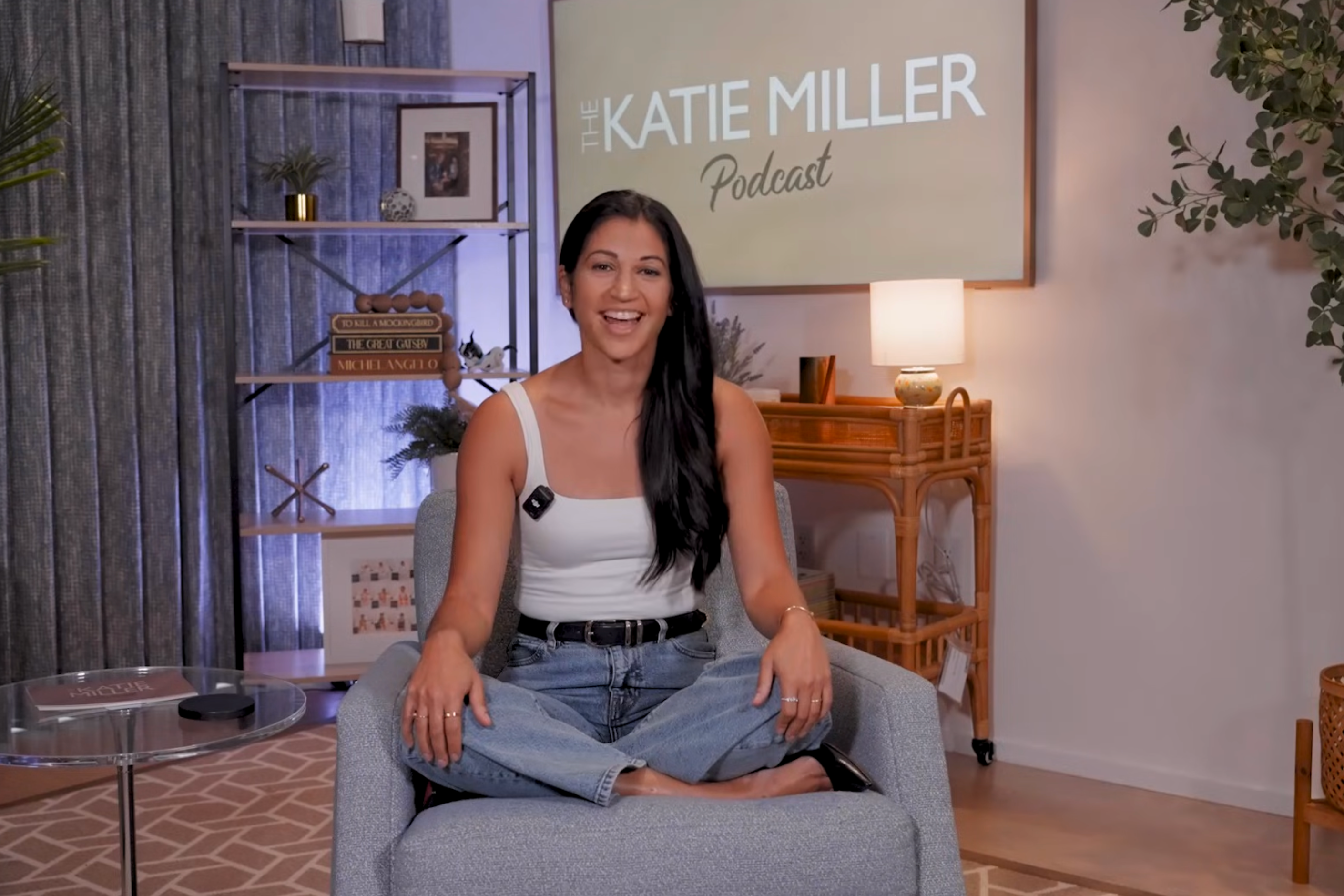
So Miller announced her podcast in a video shared to X in August. In the video, Miller sits cross-legged in a gray armchair, wearing jeans and a white tank top, surrounded by soft lamps and plants, a copy of The Great Gatsby peeking out from a bookshelf behind her. “As a mom of three kids, who eats healthy, goes to the gym, works full time, I know there isn’t a podcast for women like myself,” Miller tells the camera. Bringing white women closer in line to their male counterparts would sharply reorient our politics and, if durable, could lead to something that looks like a permanent MAGA majority.
On some level, Miller is a strange choice for America’s trad-wife in chief. She married Stephen in 2020 at the Trump International Hotel, with the president himself in attendance. She too was a political player: She fell in love with Stephen over family-separation policies while she was working as a spokesperson for the Department of Homeland Security. (During her tenure at DHS, officials sent her to the southern border in the hopes that what she saw there might make her a little more compassionate. By her own telling, speaking to journalist Jacob Soboroff, “it didn’t work.”) Following her stint at DHS, she joined Vice President Mike Pence’s office as a spokesperson, later making it clear where her loyalties lay amid the bitter fallout between Pence and Trump over the Capitol riot. Earlier this year, she worked for DOGE, the Department of Government Efficiency, under Musk.
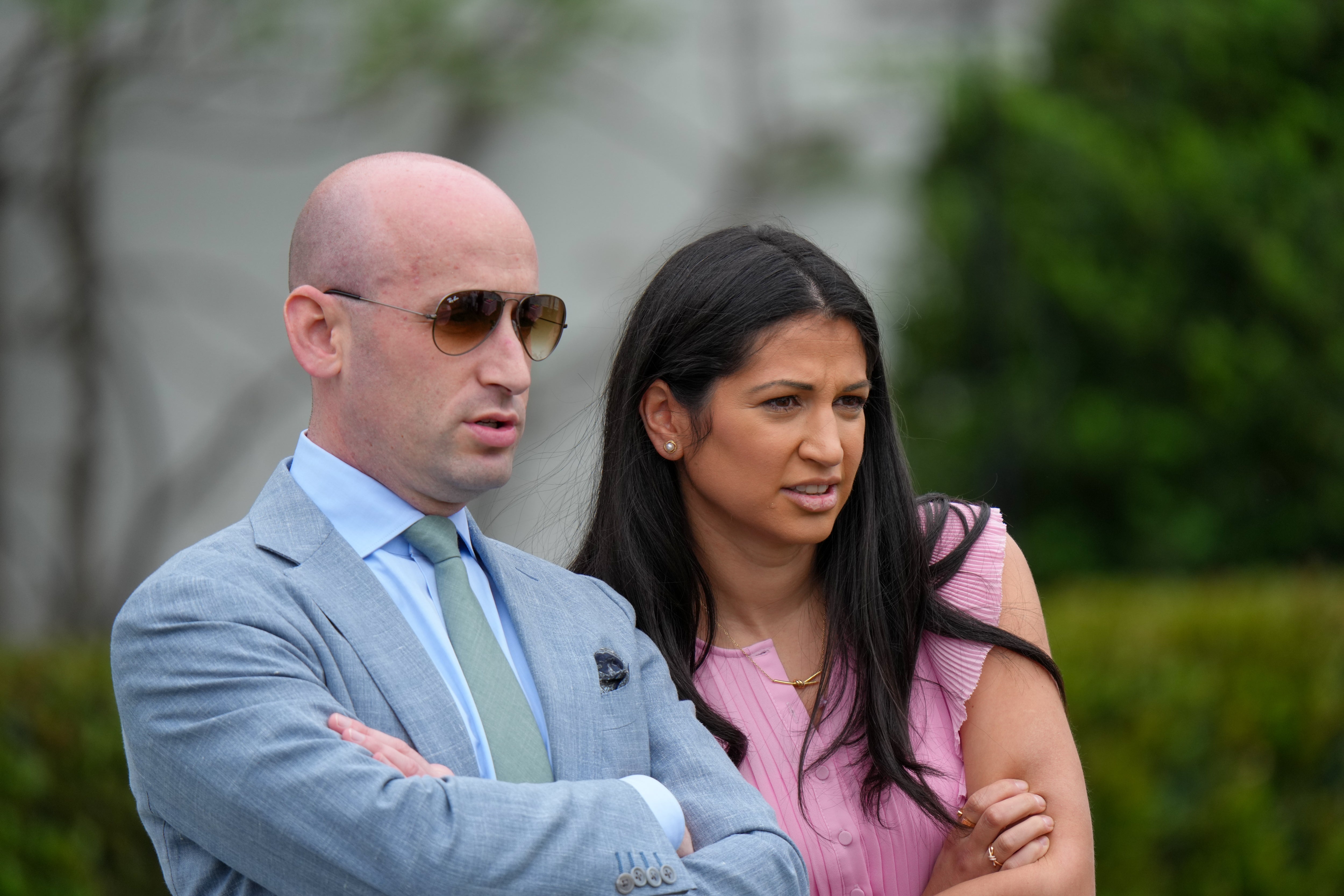
And so Miller’s new position—in which she emphasizes her role as a wife and mother to three young children—has entailed a bit of a rebrand, shedding the image of a government attack dog in favor of a softer archetype. “When society told women that our value was derived from our ability to make an income instead of derived from the joy of motherhood we all failed,” Miller wrote online in October. “Make babies. Raise those babies. It’s our highest and best value.”
When I started talking to people who knew Miller before she was a retrofitted, would-be MAGA icon—before she ever met Donald Trump—they described a person with some altogether different ambitions. Through their eyes, the entire public project of the Millers takes on added dimensions. And it all helps explain why, if you look closely, it’s clear something has gone awry with the fantasy Katie Miller is trying to sell.
Before she was the bride of Stephen Miller, Katie Miller was 15-year-old Katie Waldman, attending the first debate class for the 10th grade of Cypress Bay High School, in Broward County, Florida. During the class, which was held in a portable trailer due to overcrowding, students were tasked with a graded assignment to give a short speech about themselves.
Miller’s address was particularly memorable: “She got up and said, ‘My father is a litigator, and my mom is a MILF. She does nothing but drive up and down the highway in her SUV until it’s time to pick me up from school,’ ” one former classmate told me. “What she meant was, ‘My dad is a rich guy, and my mom’s hot. That’s who I am, and that’s where I come from.’ She was super proud.”
Miller was raised in Weston, a suburban fever dream spread across 10,500 acres of what, before being drained for development, was once Everglades wetland. Weston was built by Arvida, the same company that designed Disney World and Celebration, the Disney-owned planned community. It’s meticulously organized perfection: Its various neighborhoods, gated communities, parks, and street are pristine and feature shallow lagoons and golf courses, palm trees and hibiscus, blue skies and backyard swimming pools. One comparison kept coming up when I interviewed people for this story: It was like The Stepford Wives, a place where rich dads go to work and hot moms pick up the kids in nice cars.
Weston was developed all at once in the 1990s and quickly cemented a reputation as a haven for “white flight,” only instead of white people fleeing Black people in inner cities, they were escaping the influx of immigration from Latino and Caribbean countries into Miami. In an interview with the Washington Post in 1998, Weston’s developers described the new suburb as “Our Home Town.” “It’s more like America,” one of them said.

Glenn J. Waldman and his wife, Sheryl, left their 2,000-square-foot home in northern Miami in 1994, after their daughter Katie was born, and bought a property in the neighborhood of Weston Hills, one of the most prestigious gated communities in Weston, where homes are painted in mandatory hues such as Champagne Dance and Grandma’s Linen. The Waldmans, who are Jewish, had three children in total, and Katie was the middle. Glenn Waldman was a longtime donor to Republican lawmakers, bucking the overwhelming liberal slant in Weston, which is currently represented in Congress by Democrat Debbie Wasserman Schultz.
As for Miller, former classmates remember her as having broadly conservative politics, but they say she was fairly liberal on social issues. Ryan Terrell was the captain of the debate team at Cypress Bay High School and coached her in debate for a semester. Terrell was one of the few openly gay kids at Cypress Bay. “When she got married to Stephen Miller and got more involved in conservative circles, I thought it was interesting, because we had this whole social culture-war issue and I never saw Katie advocating for banning it,” Terrell said. “We had political discussions back then, and she never seemed to be homophobic or having issues with the LGBTQ community.”
Miller was popular in the sense that she was part of a clique and had social status, but her former classmates said that popularity shouldn’t be confused with being well liked. “She was someone who was very interested in befriending others for status, more so than being a friend,” one classmate recalled. “She would drift towards whoever was in control or popular or whatever. A friend to many, but not really a good friend to any.” Former classmates remember her as wearing Juicy Couture tracksuits over a white top, poker-straight hair tied up in a ponytail. “She was very Valley Girl–ish,” Terrell said, “a teenage girl from an upper-income family in a wealthy neighborhood. She kind of talked like that, just without the California accent.”

She worked as a photo editor for the award-winning student newspaper the Circuit, which was featured in an MTV reality show, The Paper. She left there with plenty of critics: “You’re never surprised when you hear about something bad that Katie Waldman did,” said Emmi Weiner, who was an entertainment editor at the Circuit.
Miller was apparently happy to court controversy even as a teen. A 2020 feature in Vanity Fair about the Millers’ engagement resurfaced an incident involving Katie and a widely respected English teacher, Simone Waite—one of the school’s few Black faculty members. Waite had been teaching Toni Morrison’s Beloved, which provoked discussions about slavery. When Waite said that one of the many sins of slavery was that it erased Black people of their history, Miller objected. “Couldn’t they just tell each other about their history?” she asked, according to the Vanity Fair report. She wouldn’t let it go and, after Waite suggested they “agree to disagree,” left the class and drafted a petition accusing Waite of psychological damage, calling the teacher “sickening.” The issue was eventually resolved following a meeting involving Miller, her father, and Waite—during which they agreed to take Miller out of the class.
The world that shaped Miller’s early years was one of suburban perfection and sheltered artifice, a nostalgic ideal so far removed from reality that it shares a developer with Disney World. In many ways, it’s a fantasy that’s not far from the promises of MAGA.
Aug. 11, 2025, was a difficult day to soften the Trump administration’s rough edges. It was the same day that the president announced a de facto takeover of law enforcement in the District of Columbia, complete with National Guard troops in the streets and armored vehicles parked in front of Union Station. Although executed under the auspices of fighting “rising crime,” despite violent crime rates having decreased in D.C. since 2023, the maneuver also functioned as a declaration of MAGA dominance over a blue city.
Aug. 11 was also the airdate of Miller’s podcast’s first episode, featuring none other than Vice President J.D. Vance. The lighting in the video version was soft, and the topic was domestic bliss. Vance, an unapologetic apostle of Trump’s far-right agenda, spent much of the 45-minute interview playing a jolly sitcom dad who impersonates an “ogre” at Disneyland, makes cheesecake on weekends, and insists upon the whole family gathering for dinner at the dining table each night. Other topics mentioned included Vance’s fandom of Magic: The Gathering, his opinions on cargo shorts, his “dad icks,” his preferred memes, and his “secret to keeping his marriage solid.” (He and Usha read the same book and discuss it.)
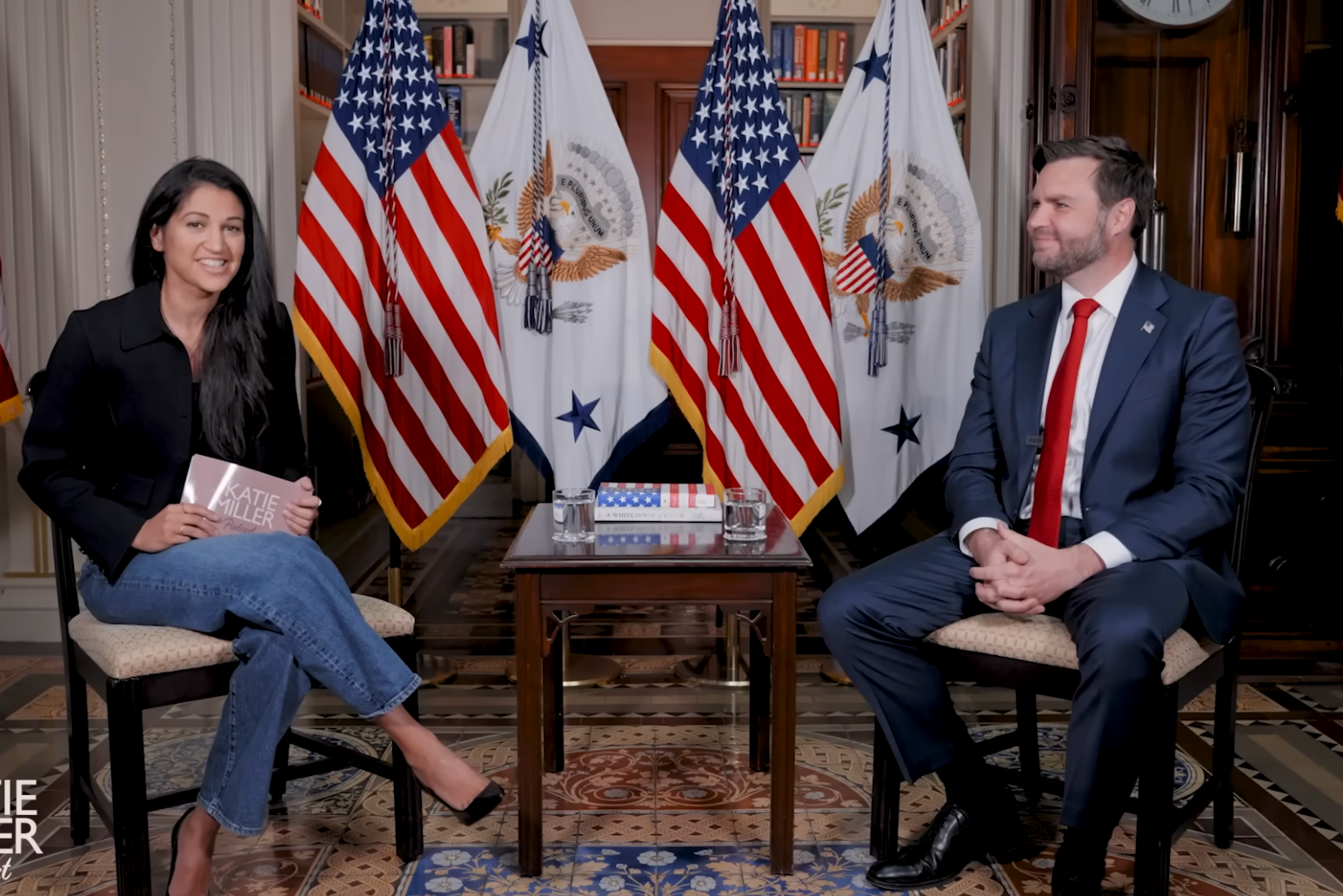
The interview is utterly anodyne, a doddering exchange of pleasantries and carefully selected humanizing anecdotes. If you were to watch it in a vacuum, you’d have no sense of a country in a time of mass transformation. There’s no probing of Vance’s real views on domestic life, including his position that well-educated women who prioritize careers over starting families are choosing a “path to misery.”
Miller likes to conclude her interviews by asking her subject which three people, living or dead, they’d invite to dinner. Vance’s answer: Isaac Newton, Abraham Lincoln, and Donald Trump.
After Weston, Miller went to the University of Florida, her father’s alma mater, and pledged to the Alpha Omicron Pi sorority. She joined the ruling party of Florida’s student government, which presided over some 60,000 students, in an initial foray into politics that was, to say the least, eventful.
Back then, Florida’s student government had a reputation of operating a little like an autocracy. The governing party—which has changed its name over the years but was known as the Unite Party at the time Miller joined—was ruled by the iron fists of privileged frat boys and sorority girls, who controlled the school’s spending and were tapped for access to the exclusive Florida Blue Key society. After graduation, they were funneled into elected office and law clerkships.
Miller, typically seen on campus in the sorority girl’s uniform of Nike shorts and a sorority-branded raincoat, quickly established herself as a power player in this world and operated like a “henchman” for the ruling party, said one former student. Members of opposing parties in student government typically were collegial with one another, socializing together despite disagreements. Not Miller.
“Katie’s a very tenacious, self-assured individual,” recalled Jordan Ball, who was a senator for the opposition party. “She looked down on people she didn’t agree with.” Another former member of the student government described Miller’s approach to politics as “tribal.” “Most people in student government would be cordial and nice and would try to work together,” they said. “I feel like it was Katie’s whole life. She took it all very personally.”
Multiple people I spoke to said that the Unite Party, which was overwhelmingly white, had a pattern of punishing Black and Hispanic affinity groups financially if they didn’t rally behind them during campaigns. “It was an open secret, but it still seemed strange on the outside, like, Why are these groups kowtowing to sororities and frats which were mostly white?” recalled one former member of student government. “Those groups would end up endorsing a bunch of frat bros.” (In 2016 those claims were among the many grievances that drove the student-led #NotMySystem movement, which called out the elitist and even corrupt practices of majority student government.)
In 2012, her sophomore year, while serving on the rules and ethics committee of student government, Miller was embroiled in a scandal. The head football coach had endorsed a candidate from the opposition Students Party, and the Independent Florida Alligator, the college paper, ran a front-page story publicizing it. Two people—later revealed to be Miller and former Student Government President Pro Tempore Jason Tiemeier—were spotted dumping 268 copies of the newspaper on the eve of student elections.
“Especially after stealing the newspapers, she had a reputation, not just with us, but throughout the whole school, of being unethical,” said Ford Dwyer, who was a senator for the opposition party. Some people who knew her told me that they were a little scared of her back then, pointing to what they saw as a vindictive streak. Despite this reputation, Miller continued to rise through the ranks of the Unite Party, acquiring more and more power and responsibility, including being appointed to chair the allocations committee.
Her ascent after all this was the subject of numerous editorials in the Independent Florida Alligator, including one with the headline “Katie Waldman Should Resign.” “Sen. Katie Waldman’s appointment to the position of allocations chairwoman is an affront to the students of UF,” wrote Max Stein, who was part of the opposition party. “I do not question her qualifications, passion or work ethic. I question her ethical and moral fiber.”
The paper’s editorial board didn’t pull any punches either. “With the recommendation that Waldman head a committee, bad behavior is being rewarded and the corruption continues to seep deeper into the fabric” of student government, the board wrote.
The Unite Party went on the attack against the student newspaper. “They have thrown away journalist integrity,” candidate TJ Villamil said in a video posted to YouTube. “Misrepresenting facts, inaccurate quotes, and completely falsified stories are just some of the few ways they’ve attempted to skew my message to the voters.”
After a tenure in the senate that was defined by scandal, Miller was not invited by party leadership to run for her seat again. Departing senators are typically invited to get up and give goodbye speeches, and Miller’s was, by all accounts, memorable. She was bitter about not being asked to run again and felt betrayed. She delivered a glowering, chaotic speech that was full of tacit threats. “The sense that everyone got was that they’d better all be careful or else, because she had information on them, and she better be respected because she had secrets that she might or might not reveal,” Dwyer recalled.
The circumstances surrounding party leadership’s decision to ultimately remove her from power in 2013 remain a mystery and were subject to much speculation and gossip, particularly as those leaders were seen as her closest friends. But Miller’s fiery speech also got people talking: “It left a very big impression,” Dwyer said. “I think she felt like a victim.”
Narratives of victimhood, disenfranchisement, and persecution have been foundational to the collective identity of the MAGA movement. Trump has regularly cast himself as the ultimate martyr, routinely claiming that the system is rigged against him and his supporters by all manner of nefarious forces. “There has never been a president who was so evilly and illegally treated as I,” Trump declared after a New York judge scheduled sentencing for his criminal hush money conviction on Jan. 10, 10 days prior to his inauguration.
And Trump’s disciples, including Katie Miller, insist they are being persecuted by the very same forces.
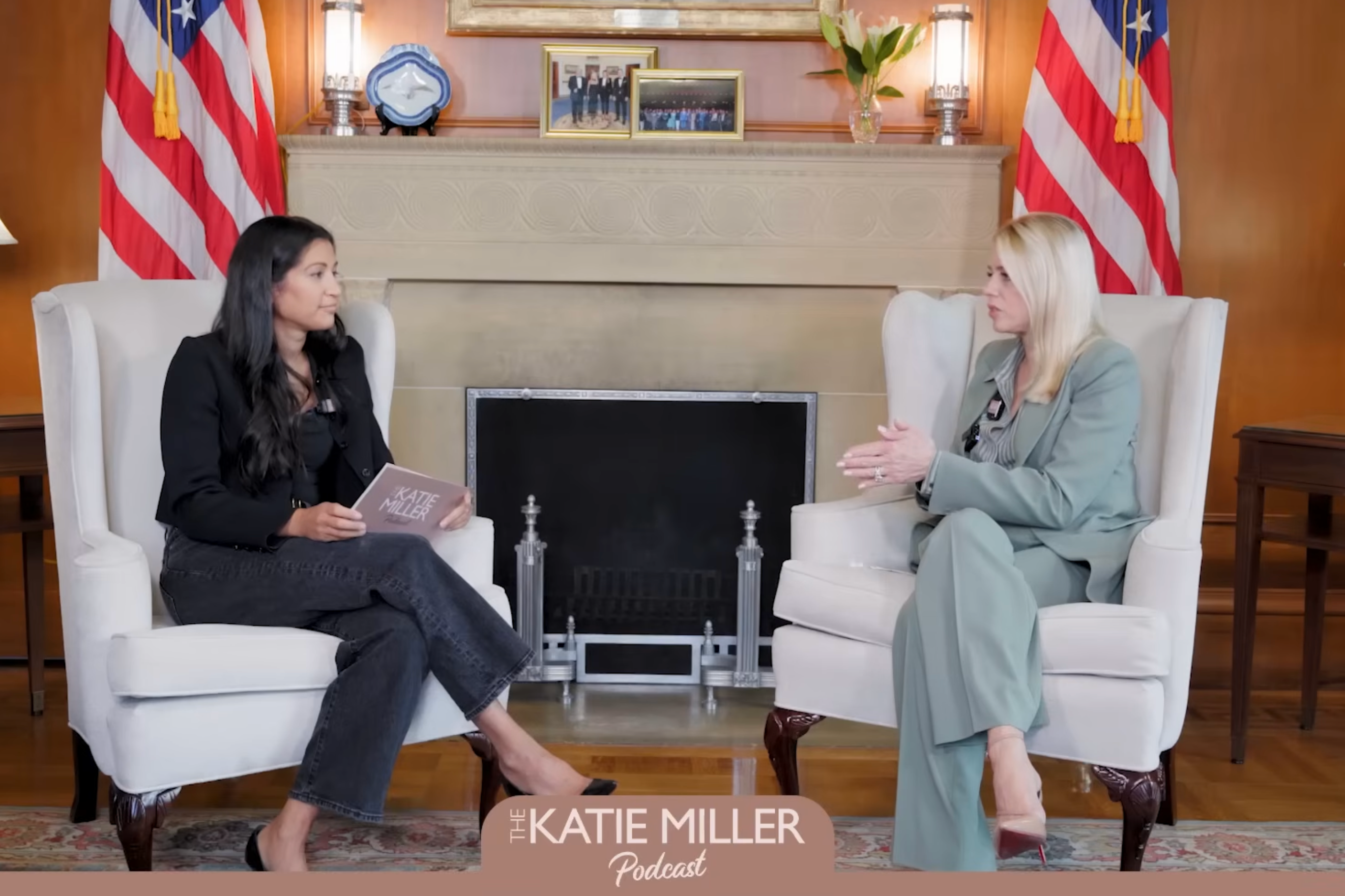
By the time Pam Bondi appeared on Miller’s podcast on Sept. 15, MAGA victimhood was cresting. It was five days after the shooting of Charlie Kirk, and the administration was determined to forge the killing into a broader narrative of anti-conservative persecution. There was discussion of the rising threat of antifa and left-wing political violence, of how Bondi survives “ugly, hateful” comments online and from in-person protesters, and of the LGBTQ agenda coming for America’s Christian children. “I think a lot of moms have come forward now, since they were putting this crazy ideology in our schools, these transgender books for elementary schools,” Bondi said. “They’re mama bears, and they’re coming out, and they’re going to run for office, and they’re going to become more vocal.” (Miller has also talked about how she pulled her daughter out of day care after the kids read a children’s book about gay penguins in New York’s Central Park Zoo.)
“Victimhood is currency for women on the far right,” said Seyward Darby, author of Sisters in Hate: American Women on the Front Lines of White Nationalism. “Women in this space hide when they play the victim. They hide their complicity. They play the ‘I’m just a nice woman or wife or mother or all of the above’ card and suggest that criticism of them is unwarranted because of that. They try to make themselves untouchable.”
Miller has played that card herself. During a panel appearance on Piers Morgan’s show this fall, she got into an argument with Turkish American commentator Cenk Uygur after he criticized her husband for lying. “Piers, quite frankly, I’m really sick and tired of this racist bigoted rhetoric that can come from people like you against my husband, against my family and my children,” Miller said in a raised voice. “I am raising Jewish children in this country.”
She continued: “You better check your citizenship application that everything was legal and correct,” she said. “Because you’ll be just like Ilhan Omar coming next.”
After college, Miller rose quickly through the ranks of the Republican Party, working for senators and the first Trump administration, where she met her future husband. The pair married in 2020. During the Biden years, Miller served as a senior adviser for P2 Public Affairs, a firm linked to Florida Gov. Ron DeSantis. At the time that Miller joined the firm, DeSantis was Trump’s main competitor for the 2024 Republican nomination. “It was not lost on others in Mr. Trump’s circle that the Miller family seemed well hedged for any outcome,” a report in the New York Times noted. After Trump clinched victory in the 2024 election, Miller came aboard his transition team as the media contact for Health and Human Services nominee Robert F. Kennedy Jr. She told Politico that she had no plans to join the Trump administration and would remain at P2.
That soon changed. Elon Musk, who credited himself for Trump’s win, had become a near-constant fixture at Mar-a-Lago (much to the chagrin of Trump insiders) and was mapping out an expansive role for himself in the new administration. That role ended up being the head of the Department of Government Efficiency. The president wanted Miller involved. “Katie Miller will soon be joining DOGE!” Trump posted on Truth Social. “She has been a loyal supporter of mine for many years.” Miller became Musk’s henchwoman, and Musk regularly spent time at the Millers’ residence. When Trump and Musk’s relationship inevitably imploded—their high-profile breakup playing out over a string of caustic posts online—Miller reportedly demurred from taking sides, and even had plans at one point to continue working for Musk in his private projects after he left the government.
She never followed through with those plans. But she did have Musk on her podcast earlier this month. Though it’s a low bar, the Musk episode is perhaps the most compelling of the bunch. He’s without question her biggest-name guest, someone whose daily habits, internal life, and personal tastes could be of genuine interest to the viewer. They discuss a range of subjects, such as Musk’s frustration that fashion isn’t evolving quickly enough, his views on DOGE’s legacy, and A.I.
But before long, Miller’s interview style arrives to once again flatten the proceedings. “Cheeseburgers are amazing,” Musk declares at one point. “A genius invention.”
The paradox of many content creators in the womanosphere is that they promote traditional gender roles—telling women that their main priorities should be to take care of their families—all while pursuing lucrative careers of their own. Miller is no exception: She may be out of politics, but her own effort to ascend in the right-wing media complex is plenty ambitious.
“There is an imperative on the far right that women, even ones who are successful in business, politics, or other worldly spaces, must be traditionally feminine and care about traditionally feminine things,” said Darby. “They must purport to believe that their highest calling is being a wife and mother. They must embrace that calling as not just a personal one but also one in service of a nationalist agenda. Katie Miller is playing her part—or trying, anyway.”
That part was on full display when Miller hosted Katie Britt, the 43-year-old Republican senator from Alabama. Britt is, by any standard, ambitious and accomplished. In 2022, at age 40, she became the youngest GOP woman elected to the Senate—and the first female senator from Alabama. She has a law degree, which she got while a mother to two young children. She was elected president of the student’s government association while at the University of Alabama. She was invited to deliver the GOP rebuttal to Joe Biden’s State of the Union last year—and did so from her kitchen, of all places. “This is where our family has tough conversations,” Britt said. “It’s where we hold each other’s hands and pray for God’s guidance.”
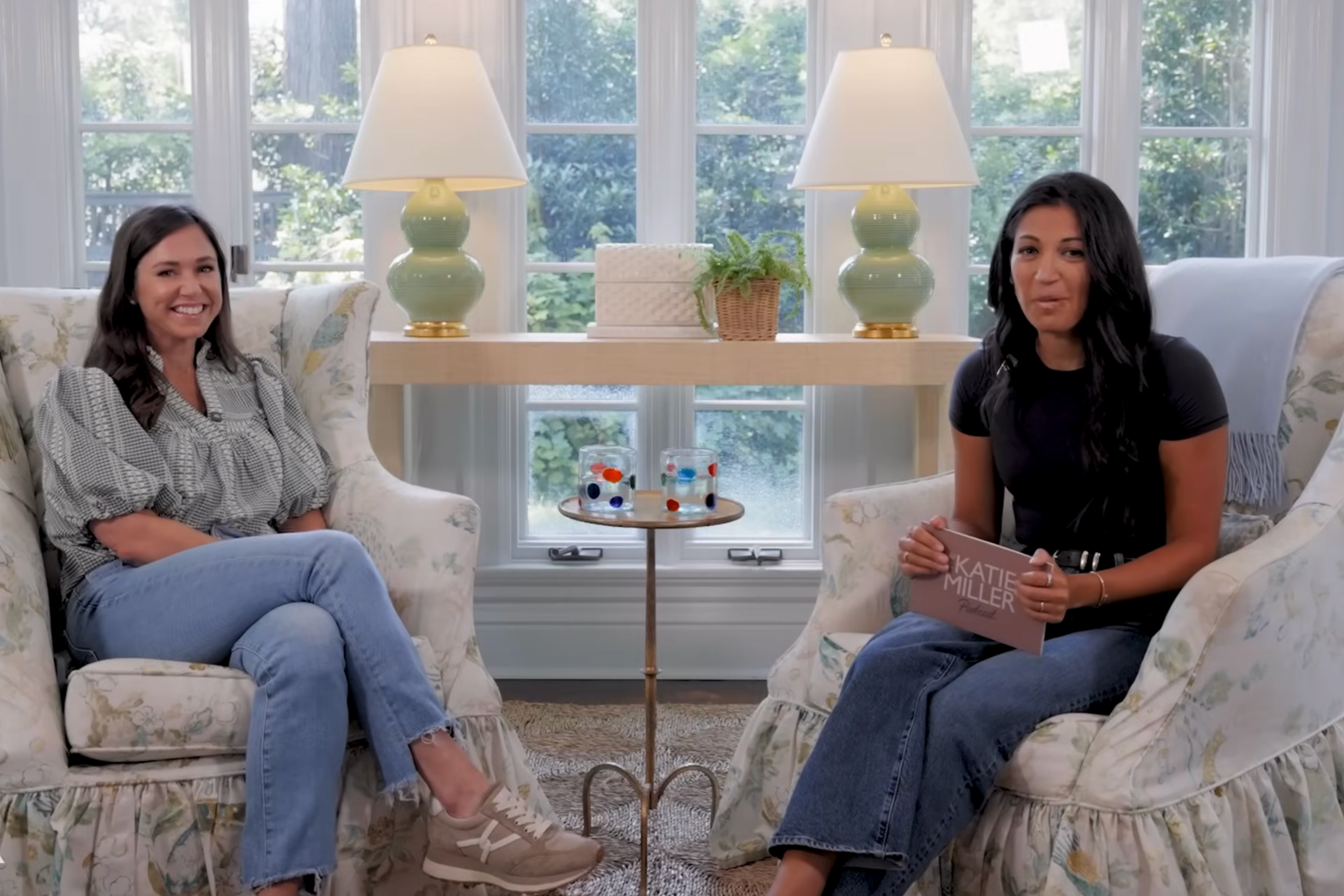
But the podcast episode with Miller seems to be an opportunity for Britt to downplay her ambition, to remind everyone that she’s a mom and a wife first and foremost. It’s filmed in Britt’s home, and the two women sit on white floral armchairs in a Southern-style sunroom. Britt is, by her own description, a “Patriot wife” because she’s married to Wesley Britt, whom she met at the University of Alabama and who was a tackle for three seasons for the New England Patriots.
Britt tells Miller that her decision to run for Senate was a religious calling, and that when her son was 10 years old, he came to her and asked to speak privately. He then presented her with a list of reasons for why she needed to run. “I want people to know how much you love Jesus,” he told her. “I want them to know what a good mom you are.” Then he added: “Mom, I definitely think they need to know about your passion for small business.”
Miller talks to Britt about her weekly schedule, which generally requires senators to be in D.C. Monday through Thursday. “Do you cook Sunday nights for family dinner?” Miller asks Britt. Britt stammers in response: “I don’t always—you know, yes, I cook Sunday nights for dinner, but I was about to say, I don’t always crush it.”
There is one more thing to know about Miller’s podcast, and that is that so far it’s a flop.
The podcast was supposed to be soft-lit counterprogramming to the second Trump administration’s daily horrors. And Miller keeps bagging major guests—veritable Trump-orbit superstars, such as Pete Hegseth and Mike Johnson and their spouses, to say nothing of Musk. And yet, despite it all, its numbers have flatlined. Most of her YouTube episodes get mired in the 10,000-view mark, with a couple of exceptions. (The Musk interview racked up half a million views.) At least for now, her metrics put her far behind the likes of other conservative women podcasters: Influencers like Brett Cooper, Pearl Davis, and Allie Beth Stuckey easily get hundreds of thousands of views on their YouTube videos. Unlike Miller, they’ve been toiling in the proverbial content mines for years, and they now have the audience to show for it.
“Despite what she said when she launched the show, she isn’t filling a gap in the cultural space,” said Darby. “There is already plenty of content out there for MAGA moms.”
If I’ve learned anything about Miller through talking to the people who’ve known her throughout her life, it’s that she cannot be happy about all this. (Miller did not respond to requests for comment.)
Where is she going wrong? Why, with her pick of MAGA world for a guest list, is Miller finding a relatively puny audience?
It’s hard to say for certain. As is probably clear by now, Miller herself is neither a particularly compelling interviewer nor one who produces the types of viral moments that political podcasts thrive on in the current era. But the project’s faults may run deeper than that. The podcast seems engineered around highlighting the softer side of this administration’s figures. And that task may be impossible for half of Miller’s potential audience and not desired by the other.
For right-leaning MAGA skeptics, who could be won over by Hegseth’s wing choices at a time when he’s reveling in obliterating small ships off the coast of Venezuela? Who’s going to believe that Bondi is an aggrieved figure at a time when her Justice Department is openly, proudly serving as Trump’s personal score-settler?
And for the MAGA faithful, are they really looking for these figures to be softened? What about this movement, born of mass rage and now on a four-year vengeance tour, suggests that the base is looking for any sort of cover?
It is, after all, a podcast aimed at making MAGA approachable to the center—and in Trump’s America, it has long been clear that the center cannot hold.
The most recent episode of the podcast features FBI Director Kash Patel and his girlfriend, country-music artist Alexis Wilkins. It begins with the disclaimer that the episode was recorded prior to the mass shooting at Brown University that left two dead, nine injured, and the shooter at large. The episode is full of idle chatter: Wilkins explains that she’s had to change her posting habits since getting booed up with the head of the FBI. Patel defends using a private jet to go see her, and discloses their shared love of a “surf and turf” night of lobster and steak.
One viewer left a comment: “We are not a serious country.”