
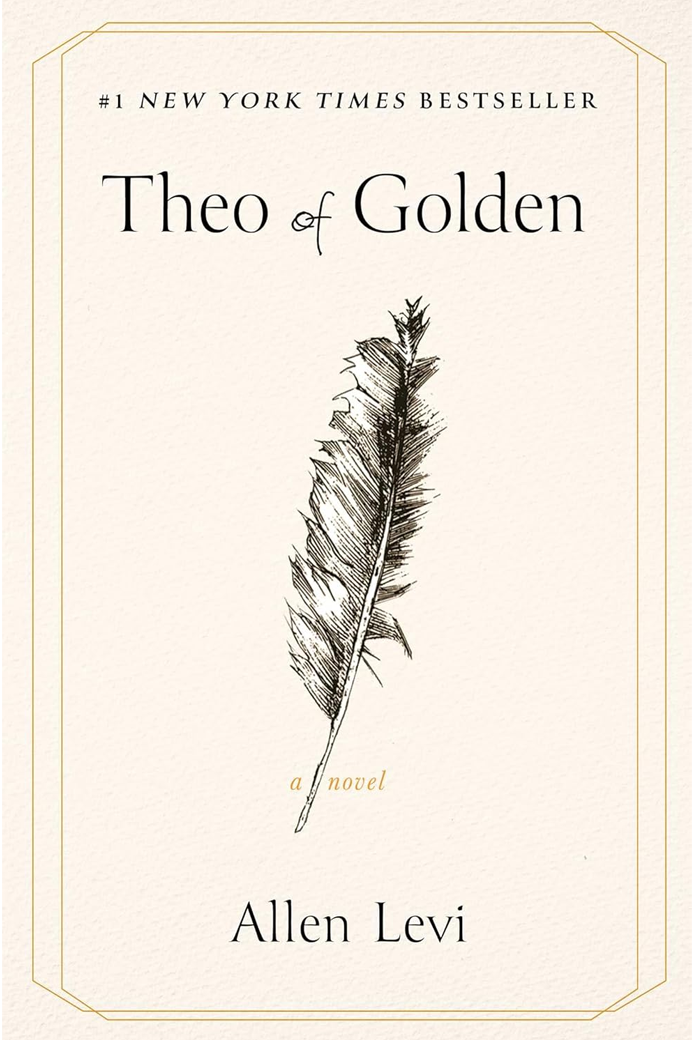
Theo of Golden, an unexpected hit of a novel by a first-time author, Allen Levi, just keeps coming. Levi self-published Theo in 2023, when he was well into his 60s, and promoted it through grassroots methods, building its fandom by hand. In 2025, Atria Books published the book traditionally, to such success that Theo could be found in the New York Times’ December roundup of the year’s surprise breakout debuts. But Theo wasn’t done: As of this week, Levi’s novel has been on the Times’ Best-Selling Combined Print & E-Book Fiction list for 15 weeks; last week, it was No. 1.
As with the success of Virginia Evans’ The Correspondent, another surprise literary hit from last year, Theo’s unexpected momentum is like something out of a fairy tale, a dream come true for Levi and all the aspiring first-time authors out there. But what is it exactly that people like so much about Theo of Golden? Why does it keep finding more readers, and why does it have a 4.56-star rating on Goodreads, a platform whose readers have awarded the winner of the 2025 Booker Prize, Flesh by David Szalay, a 3.74, and the winner of the 2025 National Book Award for Fiction, The True True Story of Raja the Gullible (and His Mother), by Rabih Alameddine, a 4.07? I think I may have found the answer—and it has to do with faith.
Theo of Golden is not like other inspirational books about the wisdom of elderly people, like 1997’s Tuesdays with Morrie. Theo has a plot. The story follows Mr. Theo, an 86-year-old man who uses only his first name, through a year in a Southern town called Golden. Theo moves to Golden without knowing a single soul there, and spends the year buying up portraits of its residents done by a local artist and gifting them to their subjects. In this way, he creates a network of friends with enviable quickness.
First, Theo sends a portrait’s subject a handwritten letter on fine paper, promising that he’s “a harmless old man, a widower, a father, a toothless lion with only innocent intentions.” When they come to the prearranged meeting place, they meet a “spry, bright-eyed soul.” (Theo, Levi emphasizes, is not a “relic” or “frail,” despite his age; rather, he’s a “young old” with “vigor” who rents an apartment with three flights of stairs that he loves to climb, even with suitcases.) Through his total, sincere interest and genuine presence, Theo, like a freelance therapist or a wandering priest, guides the portrait subjects into conversation. In the fall of his year in Golden, when Theo pauses his portrait “bestowals” due to weather, he reflects on his experience so far: “All forty-three recipients had been told they were capable of saintliness … All had been given a description of what Theo ‘saw’ when he studied their faces in the frame. Almost all were, or seemed to be, grateful for his generosity and equally grateful that someone wanted to hear their story.”
Through the device of the bestowals, we meet a range of Golden residents, from Tony, a Vietnam veteran and bookstore owner, to Ellen, a homeless woman with an unspecified mental illness, to Simone, a music student at the town’s university, to Kendrick, a custodian whose daughter is in the hospital recuperating after a car accident that killed her mother. Theo begins to use his largesse, which is of mysterious origins, to make these people’s lives easier. He secretly arranges for Kendrick’s daughter to have a better doctor and a college fund, tries to locate Ellen’s lost daughter, and makes plans for Simone’s parents to fly east to be at his recital; he is very good at giving perfect Christmas gifts. Most of the novel is about this web of generosity Theo weaves, and how others react to it. It’s only nine-tenths of the way through the book that we finally come to understand why this odd elderly man is doing what he does. Unlike Sybil of The Correspondent, another elderly main character who’s taking stock of her life, Theo is never in the wrong. This is a man aiming for heaven, with no doubt in his heart.
Theo of Golden’s midsection is baggy, its protagonist is one-dimensional, and, as may be clear from my gloss of the plot so far, it’s not a subtle book. This is a story for adults that unabashedly repeats its moral throughout. Although Levi said he turned down offers from a Christian publisher for Theo, this is also a Christian book, with Christian ideals and Christian details, from the name of the bustling coffee shop where Theo first discovers the portraits—the Chalice—to the story of how Theo healed from his grief at a significant loss in his life (sitting in nature, he saw a murmuration of starlings and red-winged blackbirds, and his mind settled on “a name, a hope, a Love that changed him forever”). In many instances, the message Theo imparts to the people he meets turns out to be a Christian one, about heaven or kindness. In a scene when Ellen comes into a church and disrupts Sunday service, we meet Mrs. Ocie Van Blarcum, a church “matriarch” who “knew well and lived devotedly the ethic … ‘Faith without works is dead.’ ” Ocie and Theo mutually disarm Ellen with their kindness: “They were the embodiment of goodness and mercy.” The book’s denouement features a Christian funeral service that goes on verbatim for pages and pages.
Slate receives a commission when you purchase items using the links on this page. Thank you for your support.
But Christianity isn’t the only belief system Theo brings to the Southern haven of Golden. (Golden seems like a very nice place to live. Not unrelatedly, the book was particularly popular among Southerners in its early self-published days.) Something all of these characters—Theo, as well as Simone, Tony, Ellen, and the local grandee James Ponder, who becomes Theo’s ally and landlord—have in common is an old-fashioned, almost antimodern interest in art as an expression of beauty. The book is chock-full of references to authors, musicians, and artists: Edward Albee, Eudora Welty, Pablo Casals, Aaron Copland, Antonin Dvorak … I could go on. Theo, in his tastes, is a relic, and so is his creator. “Some considered rooms like this one, fancy and rarely used, as a pretentious waste of space and a long outdated display of snobbery,” Levi writes, describing the dining room of the house where Theo is invited for a Thanksgiving dinner. “Others, of a more traditional bent, equated such rooms to a Holy of Holies, to be entered rarely, reverently, and expectantly.” The only character who doesn’t exhibit reverence toward this Thanksgiving table is the horrible Pearce, an avaricious smartphone addict (of course) who exploits his workers and manipulates his family members, and who is one of only a few people in Theo of Golden who are irredeemable.
Levi’s old-fashioned sensibility comes through in other ways that more politically correct readers might describe as record-scratch “Dad, we’re not using that word anymore” moments.
Describing a tree still alive in Golden’s downtown that used to be used for lynchings, Levi quotes an “old soul who had actually been alive to witness such barbarism,” writing out this elderly Black person’s way of speaking in phonetically rendered African American Vernacular English—a practice that 19th-century novelists and 20th-century gatherers of stories about slavery once followed without thinking twice, but one that many contemporary writers, especially white writers, shy away from. And then, the first portrait recipient, Minette, turns out to have a motivating tragedy straight out of an anti-abortion pamphlet: Pearce, her business-minded father, convinced her to terminate a pregnancy so that she could better pursue her career, but what she really wants is to be a mom, and it’s tearing her apart. The car accident that put Kendrick’s daughter in the hospital, we find out, was caused by a Guatemalan immigrant, described as “an illegal” and a “little man.”
Despite some of these eyebrow-raising tidbits, Theo of Golden is, at its heart, a work of old-fashioned, liberal-minded Christianity. I suspect that is how the novel found its mainstream popularity: This is the kind of “works, not prayers” Christianity that has fallen out of the public eye as right-wing evangelicalism has become increasingly dominant. The Guatemalan immigrant turns out to be a bricklayer with no criminal record, who was trying to get back to his own little girl—a cancer patient—when he fell asleep at the wheel. Kendrick’s grandmother, advising him whether to pursue legal punishment of this immigrant, says: “Baby, they’s justice and they’s mercy. If you not sure what to do and you gotta choose one or the other, I say always go the mercy way. If you make a mistake, make it for mercy. Bad mercy don’t hurt nearly like bad justice, and always remember, the eye of God can see.” And that’s what Kendrick does, influenced by Theo and by his own daughter’s inclinations to forgive: He goes the mercy way, and the driver is let off with time served. It helps that Theo has anonymously paid for a lawyer for his defense.
As this story shows, Theo of Golden is not just a Christian novel—it’s a sentimental novel, in both the contemporary sense of the word and the 19th-century one. I imagine the character of Theo as another Little Eva, the daughter of the slaveholder St. Clare in Harriet Beecher Stowe’s Uncle Tom’s Cabin. In that story, Eva’s capacity for Christian sympathy draws her close to the similarly minded Uncle Tom, allows her to befriend and soften the young enslaved girl Topsy, and convinces her hard Northern aunt, Ophelia, to recognize the humanity of all of the enslaved people on their plantation. Like Eva’s, Theo’s goodness radiates, influencing everyone to speak to one another, to befriend, to reach out and offer support.
If this sounds didactic, it is. After all, this is a novel about a secular saint. Considering Theo of Golden’s clunkiness, its old-fashioned sensibility, and its painful sincerity, I would have guessed that this kind of book would be dismissed as passé these days. It says something about readers’ longing for a certain depiction of faith and morality, I think, that it was not.